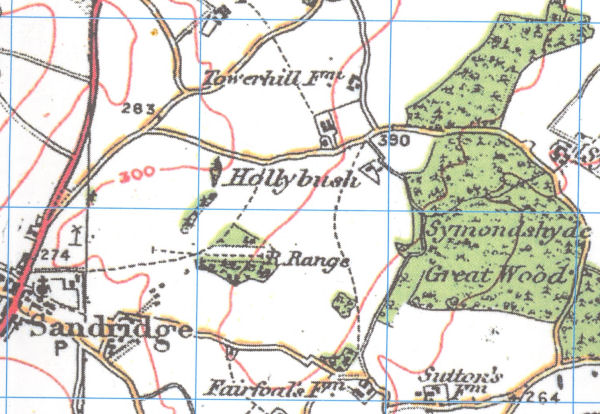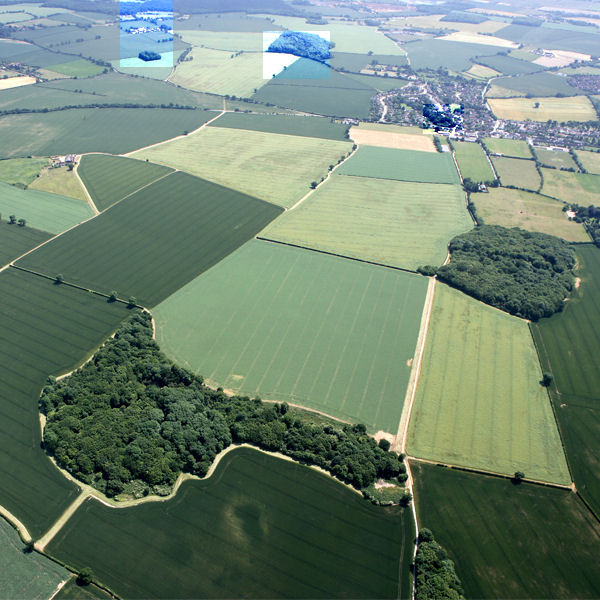
This picture is from the Woodland Trust web site. Almost all the fields, and two large wooded areas are part of Heartwood Forest, a major project to restore a large area of fields to native woodland in Hertfordshire. For a mere £15 you can dedicate a tree to be planted in what will be an 850 acre forest. I already have a page about the new forest but three areas in the picture are of particular interest to my ancestors, in addition to most of Heartwood Forest area having been farmed by a relative in Victorian times.
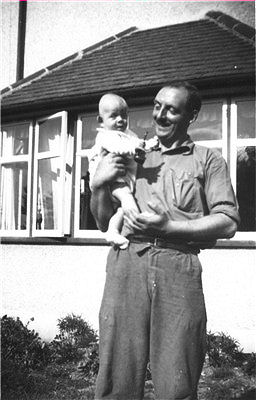
In the top left is a farm (highlighted) with a spinney in front of it and a light coloured field beyond. The Farm is Hammonds Farm which was farmed by my ancestors, William Cox (1760-1802), Thomas Cox (1794-1874), Henry Cox (1826-1882), Jacob Reynolds (1835-1926) and Harry Finch Reynolds (1865-1947). My father Gerald Finch Reynolds (1907-1977) worked on the farm, and helped to plant the spinney (in part I suspect, as cover for foxes) probably around 1930. When he married in 1937 he built a house, Eylotts, on the light coloured field, which had been the poultry farm area of Hammonds Farm. I was born there (well technically in a nursing home in St Albans) but the farm was sold in 1939. So after 7 generations who had lived at least part of their lives on the farm the family moved away from the area.
The small wood highlighted to the right is the site of the former Sandridge Rifle Range, which extended into the fields in front of it - the trees surrounding the butts. The two fields in front are part of Heartwood Forest and when I visited this summer were full of very young trees, although most were still not higher than the grass..
 |
| By the track from Sandridge Village towards Hammonds Farm The newly planted part of Heartwood Forest is on the left, Range Wood is straight ahead. |
Because of my connections with the area the village of Sandridge is of particular interest and many of my ancestors are buried in St Leonard's churchyard - containing the grave of my earliest traced Cox ancestor, Jonathan Cox (1688-1750). If I could link him, and the two intervening generations, to Hammonds Farm this would make 10 generations who lived on one farm.
 |
| The Cox Graves in Sandridge Churchyard The engraved top of the brick vault is now virtually unreadable but originally read Here Lyeth Inter'd Mrs. Eliz. Cox, Wife of Jonathan Cox, Gent. of St Julians in the Parish of St Stephens who departed this life January 12, 1740, in the 55th year of her age. Here Lyeth the Body of Jonathan Cox Gent. Husband of the above Elizabeth Cox who died Decebr. the 31, 1750. Aged Sixty Two When the above inscription was recorded, in about 1878, a Jonathan Cox, father and son, farmed the land which now forms most of Heartwood Forest. The other alter grave contains William Cox (1760-1802) and many members of his family over several generations. Several of the other stones are also relatives |