Showing posts with label Tring Station. Show all posts

Saturday, December 7, 2013

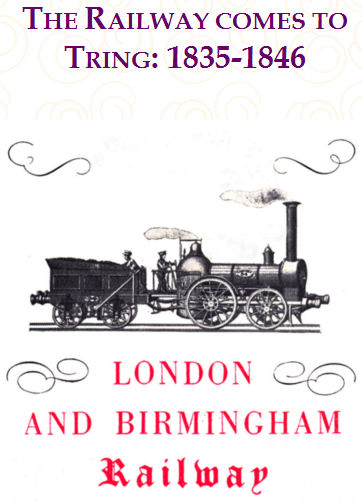
The London to Birmingham Railway comes to Tring 1835-1846

by Ian Petticrew & Wendy Austin
Books
This online book, which has just been published, is the kind of well-written local history I have come to expect from Ian Petticrew and Wendy Austin. It is a very detailed account of the building of the London and Birmingham Railway from Euston to Tring, with an emphasis of the Tring area. In addition to making extensive use of the readily accessible sources it also reprints the text written in about 1890 by Arthur MacDonald Brown (1861-1951, son of the Tring estate agent William Brown) for a book on the history of Tring which was never published. As a result it contains some useful detail of the building of the Harcourt Arms (later the Royal Hotel) at Tring Station by the Brown family.

Sunday, August 25, 2013

Exploring the History of Hastoe House, near Tring.

The Account Book


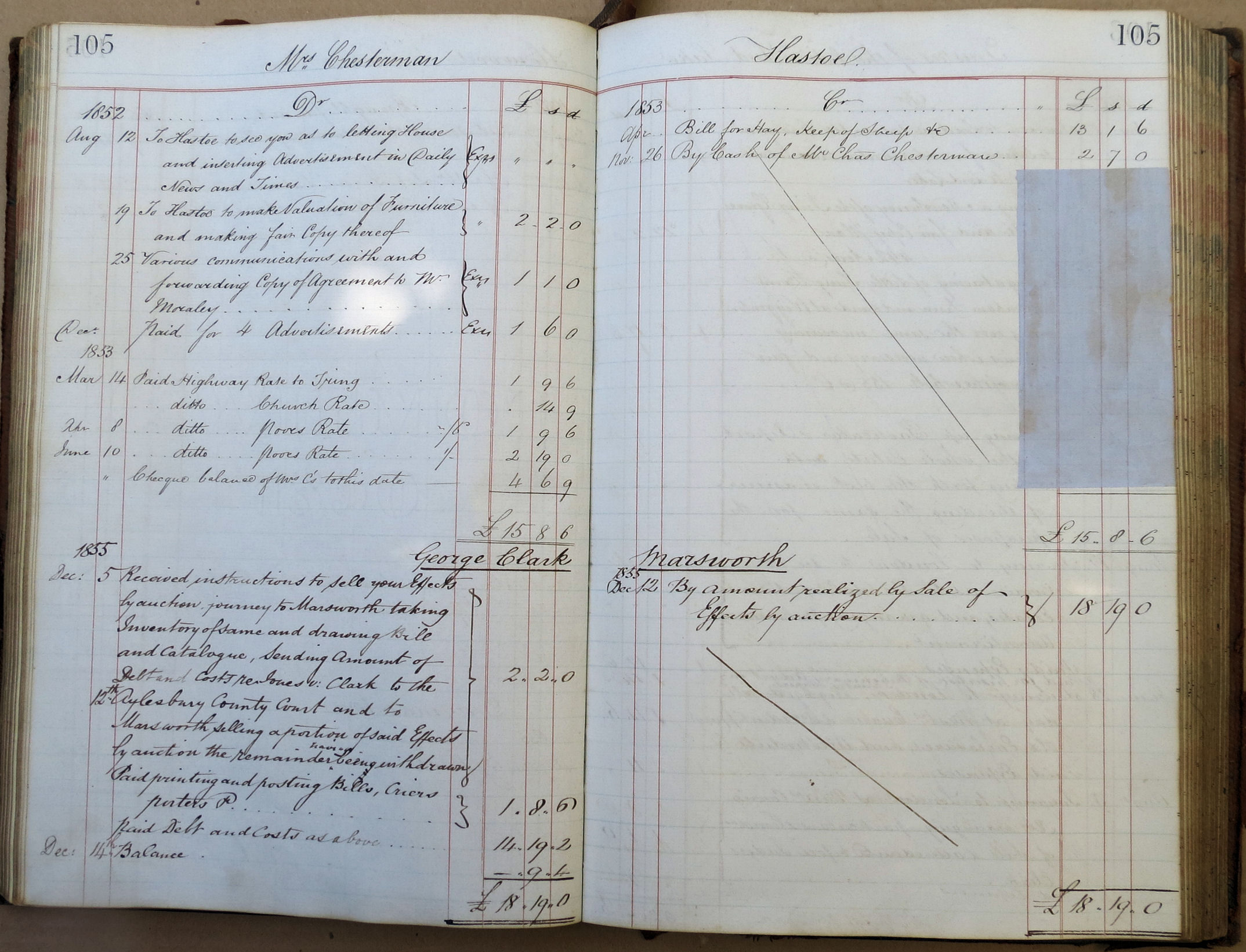
Folio 105 of William Brown's Account Book  records that a Mrs Chesterman asked him to let Hastoe House and value some furniture.

Why?

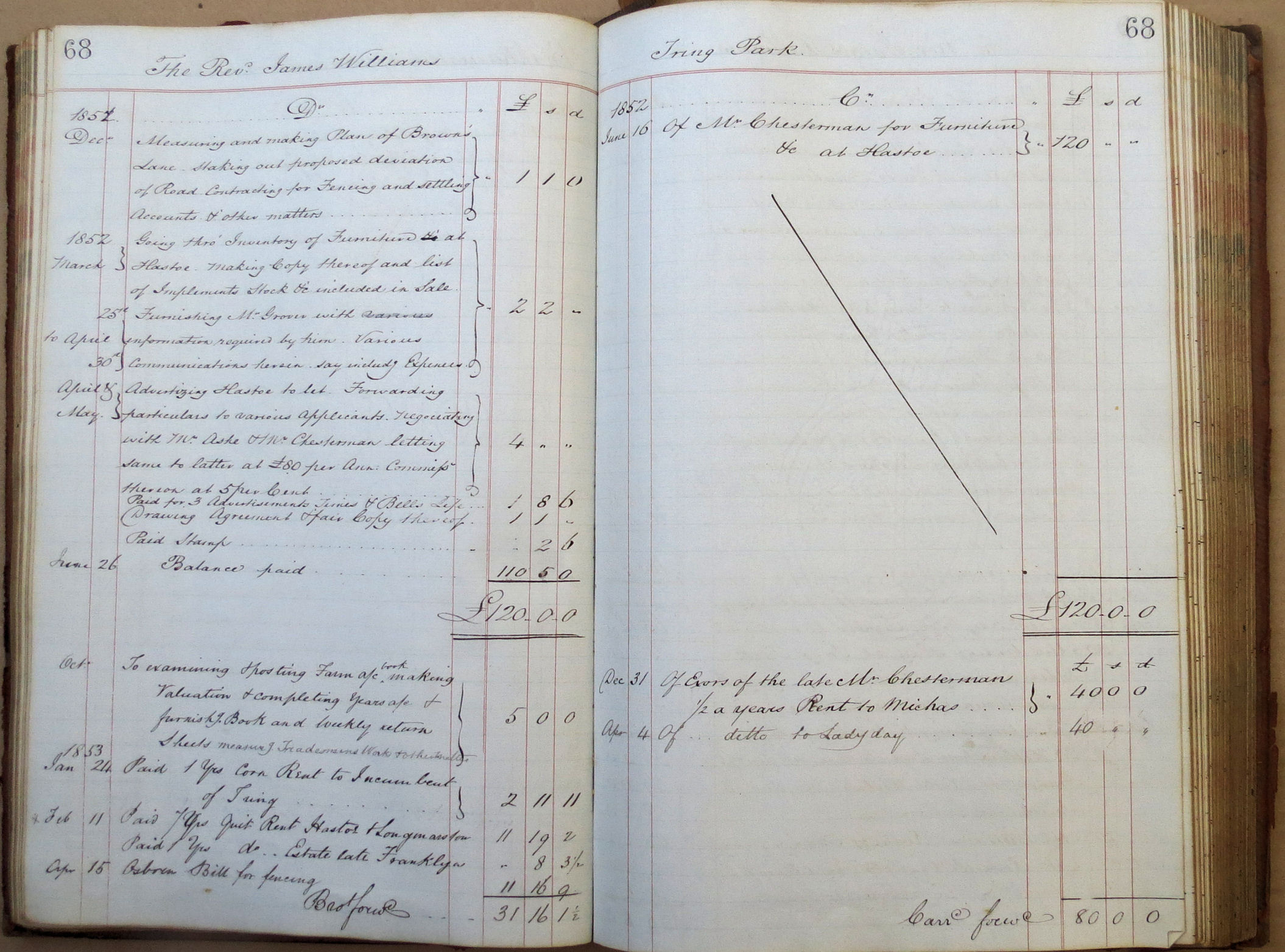
William Brown also managed the property affairs for the Rev. James Williams, who lived in Tring Park. Folio 68 shows that in April 1852 the house was advertised to let. In May Mr Chesterman agreed to rent the house at £80 per year and on 16th of June Mr Chesterman brought the furniture in the house for £120. Ubfortunately he died on 1st July, 1852 - so clearly did not have much time to enjoy Hastoe House.  William Brown's Account Book shows that the Chesterman executors continued to pay the rent until 1856 so I decided to see what happened to Mrs Hannah Chesterman - only to find that in 1853 she married William Brown's brother James!

I was hooked - and I decided to see what I could find out about the other tenants. This was made possible because all the 19th century editions of the Bucks Herald (published in nearby Aylesbury) are available on the British Newspaper Archive. A certain amount of intelligent deduction was needed - helped by the fact that Hastoe House was the only property in the Hastoe area which was posh enough to employ resident domestic servants. 

The many tenants included Baron Rothschild in 1843 (he probably used it as a hunting lodge), the son in law of the Bishop of Chichester, a "retired squatter" (not what you might think), and William Brown's business partner. It seems that another tenant, a William Burns, died shortly after taking the tenancy. The only significant gap between 1841 and 1901 is that I was unable to discover the name of the tenant who was resident at the time of the 1861 census - as only their domestic staff are recorded.

For full details, including copies of the relevant sections of the account book, various press adverts, maps, and two modern views see CHESTERMAN & Hastoe House, Tring, circa 1838 - 1901
It should be pointed out that it was possible to find so much out, comparatively quickly, because Hastoe House was the only "gentry" accommodation in Hastoe, which itself had a very small population. 

Friday, June 21, 2013

More about the Meredith Family of Aldbury and New Zealand

Aldbury
Help Desk
Richard has provided more information about Michael Meredith, and where his family fortune went - which explains why someone with a well-connected background ended up working at Tring railway station. Richard also provided details of the family journey to New Zealand - where Michael was killed by the Maoris.

See MEREDITH, Tring Station, Aldbury, mid-19th century for the full story.

Wednesday, October 31, 2012

Tring Railway Station and the Maori Wars

One of the railway workers at Tring Station. Aldbury in 1851, was Michael Meredith who later emigrated to New Zealand - and whose murder appears to have occurred at the start of one of the Maori wars.  Two years ago I answered a question from Carlene about his Hertfordshire family but failed to link the answer to the indexes, etc., on this web site. This fault has now been corrected.

In connection with this query it is interesting to revisit the pages on railway workers associated with Tring Railway Station and with the village of Aldbury  (see pages based on the 1851 and 1881 census) and the information they contain throws light on the role of the railways in moving their employees around the country.