Showing posts with label Workhouse. Show all posts

Thursday, March 13, 2014

If your ancestor couldn't write, records may be wrong

Help Desk
Braughing
When Margaret's ancestor Thomas Bradshaw (born c 1811) went to Australia in 1855 his parents were described as James and Sarah. Unfortunately online records failed to produce a suitable couple in the Braughing area of Hertfordshire. However Thomas Bradshaw couldn't read and write, so when he was asked for his parent's name he naturally gave the name of the woman he called mother - although she was actually his step mother! The matter in complicated because when one investigates the marriage between James Bradshaw and his first wife, Susanna, there is a ten year gap in child baptisms - including Thomas - probably because they were non-conformists and the relevant registers have not survived.

Tuesday, October 8, 2013

A Sequestrated Clergyman and Watford Union Workhouse

Rev Henry Goodwin
One of the sad things about ebay is the large number of Victorian portraits for sale which have lost contact with their families - and no-one knows who they are. I acquire some of them and recently I purchased two to illustrate the work of a Watford photographer, Joseph James Southwood. One was a "Fine Art Studio" carte de visite  of a tightly corseted young woman and there are no clues to her identity. The other was cabinet card of a elderly bearded gentleman, with a cross, who could well be a minister of religion. In addition there was a partial identification - someone had written the words "Goodwin father of Edward Goodwin" on the bottom.

Watford
I quickly discovered that in 1901 Edward J Goodwin was a 38 year old Wholesale Jeweller's Bookkeeper living with his father, Rev. Henry Goodwin, at 20 Westland Road, Watford. It turns out that Rev Henry Goodwin had been the vicar of Twyning, Gloucestershire, but in 1863 he had got into financial difficulties and was sequestrated and left the parish. In 1880 he became the chaplin at the Watford Union Workhouse and continued to live in Watford until his death in 1908.

Interestingly Gordon asked me about Henry Goodwin in 2001, when the only census information available online was for 1881, and my reply to him then now looks very dated.

Wednesday, February 6, 2013

More Old News from Tring

Old News
I have completed the preparations for tomorrow's talk  by adding the following additional sample news stories:

1842: Opening of the Tring National School - on the site of the old workhouse.
1849: Stealing a tea-caddy at Tring - 18 year old get whipped and 1 week's hard labour
1861: Fire at Miswell Farm, Tring - Buildings destroyed but farmhouse saved - arson suspected
1887: Obituary of Benjamin Crouch, of Miswell Farm, Tring - 93 year old farmer had seen 51 harvests at the farm (and his son continued for another 24 years). I have added some biographical details.
1890: Sale of Building Land at Tring  - Sale of plots  in the Longfield Road area I have added details from 1897 O.S. map

Monday, February 4, 2013

Old News from Tring 1724-1900

Old News
As mentioned earlier I am giving a talk on Old Newspapers to the Genealogy group of the Tring U3A later this week and I am selecting a variety of stories from the British Newspaper Archive as examples, including the following:

1724: Tring saves money with a Workhouse  This is the earliest I found - and suggests that Tring, together with Berkhamsted, Watford and Aylesbury had been able to reduce Poor Rates by using workhouses.
1740: Fatal accident in Tring Park  The son of minister, Rev. Randolph, dies in riding accident in Mr. Gore's park.
1753: A Chancery Case involving Joseph Adkins of Tring   This frustratingly short report raises the question of how someone in the workhouse can fight and win a court case in Chancery.
1853: Sale of the Tring Grove Estate  Following the death of Viscount Lake this is sold in connection with a case in the Court of Chancery
1881: Sale of Farm Stock at Town Farm, Aldbury  A routine sale of stock on a Farm
1900: Football at Tring Grove

Over the next few days I will be adding more stories - and updating  the other Tring Old News stories which have been posted earlier.

Monday, December 10, 2012

Gamel's Hall, Rush Green, Little Amwell

Mike asked if I could locate Gemmells Hall Farm and provide a picture. It turns out that Gamel's Hall - also known as Amwellbury - was rather more a gentleman's residence than a simple farm. It was at Little Amwell, also known as Hertford Heath. William Willson was there in 1841 but he had moved out and was the master of a workhouse in 1851, which would have been a definite fall in social status. I decided to look in the British Newspaper Archive to see if I could fill in any details but nothing definite turned up.  [More information]
The query highlights the need to look at census information for social status information, the problems of places that change their name, and the potential value of the British Newspaper Archive.

Wednesday, July 18, 2012

Was your ancestor born in a workhouse?

I recently got the following request, via the Ancestry message system, about a birth certificate which said: 
Well I got Charles' birth Certificate, and to my dismay the father is left blank, but his mother is listed as an Emily Tyers. I was wondering if I could send you a copy via email and you could possibly help be make out one of the words on it... Twice under Emily it list Union "Norh/worh?" House, Watford. And that she was a servant. Do you have any idea?
Watford Union Workhouse in 1896
I replied :

It always helps if you know something about the social conditions at the time - and no-one at the time would have had any difficulty with the word you are struggling with. It was the dreaded Union Workhouse. The rich grumbled about the expense and the poor were terified that they would end up there. If you want to know more about the workhouse system read Charles Dicken's book Oliver Twist.
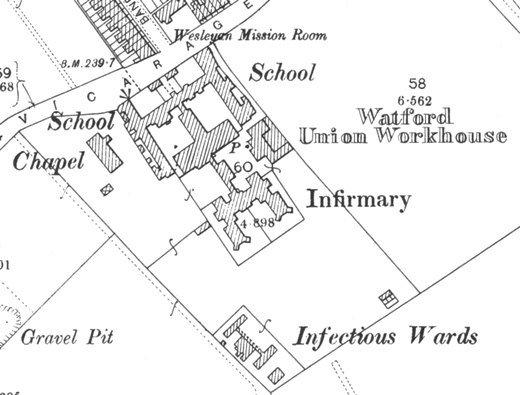
By the time your Charles Tyers was born in 1895 they were beginning to get a bit better - the children who where the responsibility of the Union were more likely to be fostered out and also sent to a proper school - rather than being taught in the Workhouse itself. 50 years later the workhouses were done away with - and as most of the residents were people who were too ill to look after themselves (often through old age) they became hospitals - and the Watford NHS Hospital is on the workhouse site, and the last time I was there some of the workhouse buildings were still standing. However there are major development plans and I haven't been there for at least 5 years.
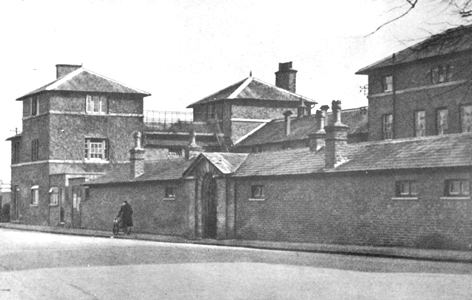
The Union Workhouse in Vicarage Road, Watford
Emily Tyers had probably been a domestic servant living in a private house away from home, and when she became too pregnant to work found herself destitute - and ended up having the child in the Workhouse. As soon as she was fit to work she would have had to find a new job, and rearing the child would have been the responsibility of the Union.
The chances of ever finding out who the father was is remote - but that is just a fact of family history - as there are similar cases in almost every family tree.
If you visit my web site at www.hertfordshire-genealogy.co.uk and use the search faclilty for the words WATFORD and WORKHOUSE you will find many references including one to the New Year party held in 1893. You will also find much more about Watford.
Relevant pages on the main site are on Watford Union, The New Year Party at the Union, and a general page on The Workhouse with an important link. There are many other pages where books on Watford refer to the workhouse, or where answers involve people who had connections with the workhouse.