Sunday, May 6, 2012

To be honest Family History research really is dirt cheap ...

O.K. I can hear some of you newcomers to the hobby grumbling about the cost of subscriptions or the cost of page views - but you don't know how very expensive it was in the past. I was reminded of this by Peter Calvar's article Is the cost of your hobby going up? on the latest LostCousins Newletter. He compared the cost of a subscription to a site like Ancestry 10 years ago with the current subscription for very much more information at your finder tips. Basically he was saying that the present day "Bucks per Bang" today is very much bigger than it was when he paid his first online subscription.

If you go further back the costs of researching your family tree were very much higher - which meant that you had to send very more time and more money (allowing for inflation) to make even slower progress.

First World War Military Career - The Case of James Humphries

Now that more and more military records are coming online it is becoming increasingly easy to trace the likely movements of your ancestor during the First World War - particularly if there is a relevant published history.

With Anthony's help in finding some key records on Ancestry and FindMyPast it is possible to trace the movements of James Humphries. He was the "J" who sent a postcard to Miss M. Rowe in 1909 - which was the starting point of a mystery post card  investigation. In one way his case is simplified because he joined the Watford Battery of the 4th Herts Brigade R.F.A. of the Territorial Force - and almost certainly stayed with it all through the war - although it had been renamed the 270th Brigade R.F.A. by the end of the war. It is also helped because the history of the Hertfordshire soldiers have been well documented by J.D. Sainsbury, in this case in The Hertfordshire Batteries Royal Field Artillery. See James Humphries' Career

Saturday, May 5, 2012

Frederick Sanders - The Orchid King of St Albans

Frank Sander (1847-1920) came to St Albans in 1876 and became a major supplies of orchids to late Victorian England - including many European Royalty. The book Frederick Sander: The Orchid King provides an insight into the world of orchid collecting. It was written by Arthur Swinson in 1970 and I say something of the St Albans connection on the Review page.

Why not share what you know if your ancestor worked for Frederick Sander - or brought orchids from him.

And a big Thank You to Mary - who provided a copy of the book.

A very unusual car in Hertfordshire

In January I asked if anyone could identify this car, and also passed a request on to the Surrey Vintage Vehicle Society who are skilled in the identification of old cars. This proved a challenge but one of their number  reported that it was a 1908 GC Light Car with Sultan 8HP engine made by Automobiles G. C. ,  H. Guyot et Cie, Paris, - and only in 1908.

There were two other cars on my Motor Car page and they kindly identified these as well. The car on a postcard in Colliers end was also a French car - a 1925 Citroen 5CV Model C - but made in Slough, while the bullnosed Morris was a 1925  Morris Cowley  Two-Seater with Dickey. [SVVS Identification Page]

In each case the date of car manufacturer can be identified to the year - which shows how useful cars can be in identifying the earliest possible date for a photograph.

Friday, May 4, 2012

Straw Platting in Hertfordshire and Bedfordshire

A straw plaiting peg doll
from Tring circa 1895
Straw plaiting was something women and children could do at home to supplement the family income and in many Hertfordshire villages, particularly around the St Albans area, it was one of the commonest occupations in the mid 19th century. Much of the plait was uses to make hats in St Albans and Luton. If your ancestor was a farm labourer in the area 150 years of so ago his wife may well have plaited straw, and his children as well.

The FindMyPast blog has recently published the following request for information.
‘Are you, were you, or do you know, a master hat–maker? If yes, we tip our caps to you, and hope that you might have something to share… We’re currently researching the hatting and straw plaiting industry in southern England - the commercial hub was in Luton, but the trade was also vitally important to people throughout Hertfordshire, Bedfordshire, Buckinghamshire and Essex. If you, or anyone in your family, worked in the trade and would like to share your memories or any photographs, we would love to hear from you – you can contact the author directly at katie.carmichael@english-heritage.org.uk’
If you add a comment below about your straw plaiting or hat making ancestors I will forward the details to Katie.


A First in the Family

Yesterday I was booked to go to London in  a coach trip with the Tring U3A Genealogy Group to visit the London Metropolitan Archives or possibly the Society of Genealogists but I was distracted by the news that the youngest member of the family was doing something that, as far as I know, none of her ancestors had ever done. She had a picture hung in a London Art Exhibition! So when the coach arrived in the City the archives were forgotten for a couple of hours as I slipped out and caught a bus to the Royal College of Art.

OK, Hanaa was only six when she painted it and it may only be a coincidence that it provides a surreal image of the desolate high rise housing estates that were built in London 50 years ago. The important thing is that the Annual Young Art Exhibitions at the Royal College of Art not only gives children at some 80 schools in the London area a chance to show what they can do, by also raises money for cancer research.

Thursday, May 3, 2012

A Rural Graveyard at Wilstone, near Tring

Cold Comfort for the Residents
If you drive along the Lower Icknield Way from Aston Clinton towards Marsworth and Pitstone you pass a field with a high hedge and a lych gate. If you stop to investigate you will find a small 20th century cemetery completely surrounded by fields.

This is the cemetery of St Cross, at the nearby village of Wilstone, and if you visit the church you will find it has a small churchyard - without a gravestone in sight. 

The reason is in the soil. The Vale of Aylesbury is very flat and the natural drainage is poor. If you dug a suitably deep grave at the church it would immediately fill with water! However a mile away, as you approach the Chiltern Hills, the ground rises slightly and the drainage is better.

I have posted a number of modern photographs of the cemetery on Geograph.

Wednesday, May 2, 2012

Was your ancestor baptised by a translator of the King James Bible?

Issue 18 of Herts Part and Present includes an article The Hertfordshire men who translated the King James Bible by Richard N W Lambert. The abstract reads:
This series of mini biographies of the Hertfordshire men who worked on the translations for the King James Bible takes us back to Jacobean Hertfordshire and the lives of eight scholarly priests. Jeremiah Radcliffe, Richard Fairclough and WilIiam Dakins were Hertfordshire born and five others, John Layfield, Francis Burleigh, John Spencer, John Overall, and Samuel Ward had links with Hertfordshire towns and villages. Learned men who shared in the work of translating from the Latin, Hebrew and Greek, many combined distinguished academic careers with a plethora of priestly appointments. One died after being imprisoned in his Cambridge college during the Civil Wars and one sailed to the New World as chaplain to the Earl of Cumberland.
It is quite possible that several of them held a pastoral appointment in Hertfordshire and if you ancestor was baptised in the right parish at the right dates they could have been baptised by one of the translators. John Layfield was rector at Graveley from 1606-1613. Francis Burley was rector of St James the Great, Thorley,  between 1594 and his death in 1619 and was also rector of Bishop's Stortford between 1590 and 1604. Jon Spencer was vicar of St Augustine's, Broxbourne, between 1592 and 1599. John Overall was rector at Clothall between 1603  and 1615 and nearby Therfield between 1605 and 1614. Samuel Ward was rector at Great Munden between 1616 and 1636.

Unfortunately the fact that your ancestor was baptised in one of these parishes at an appropriate date does not automatically mean that they were baptised by one of the translators of the best know English language bible. Often rectors did not even live in the parish, having appointed a curate to minister to the population. This is highlighted by case of Jerimiah Radcliffe who was simultaneously vicar at Shudy Camps, Cambridgeshire, Trumpington, Cambridgeshire, Eaton Bray, Bedfordshire, and Heversham, Westmorland.

Tuesday, May 1, 2012

A Detour into Buckinghamshire

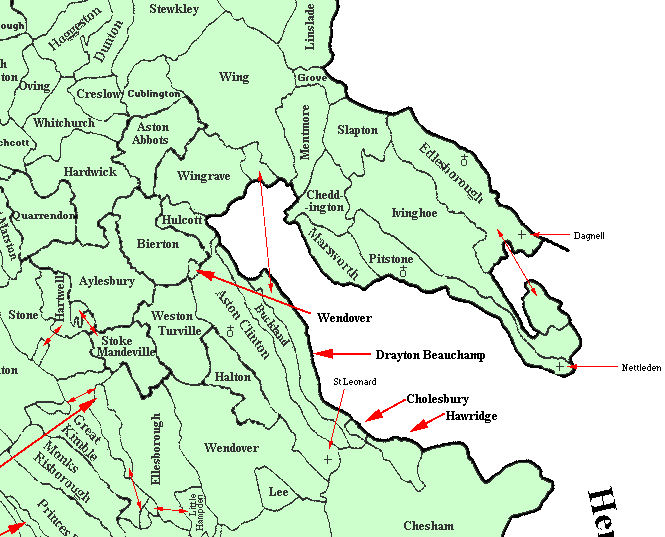
One of the frustrations of this web site has been that I live in Tring - which is the western part of Hertfordshire which is surrounded on three sides by Buckinghamshire. I enjoy walking the countryside, taking photographs of features of historical interest and well as the wild life and farming activities. With the Vale of Aylesbury to my north, and the Chiltern Hills to the east and west there is much to keep me occupied - but most of it is in Buckinghamshire.

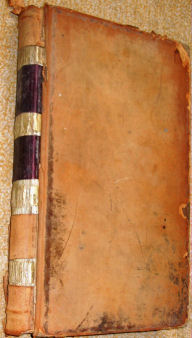
William Brown's Account Book
The point is that the county boundaries of Hertfordshire are in most places highly arbitrary - and mainly derive from the boundaries of Anglo-Saxon estates over 1000 years ago. While administrative history may limit itself to such boundaries they are for most purposes arbitrary lines which in some place are not even marked by as much as a hedgerow. Treating the county boundary as a rigid "no-cross" line causes significant difficulties if you are discussing local history.

One example relates to Tring as a market Town - when many of the people who used the market to buy and sell would have crossed the county boundary to do so. William Brown was an auctioneer in Tring in the 19th century and, when I have time, I am presenting details of his Customer Account Book which again deals with customers on either side of the boundary.

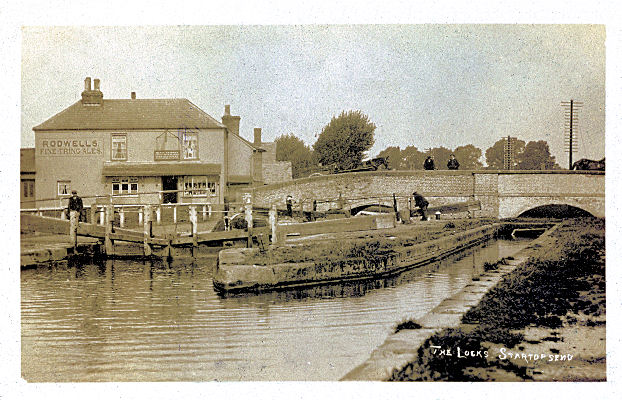
The Lock at Startops End
Another example relates to the Canal, its branches, and its reservoirs, where any account of its history automatically involves both Herts and Bucks - particularly the Bucks village of Marsworth.

To make it easier to cover issues which cross the county boundary it has been decided to introduce pages for Buckinghamshire parishes which are associated with the canal, plus some adjacent parishes in the Vale of Aylesbury. Each page will consisted of one or two old post cards images and links to my modern photographs, which will be held as high resolution images on Geograph. There will also be links to cross-boarder topics on the Hertfordshire web site and external links to other relevant web sites. There will be no attempt to duplicate the excellent information on Buckinghamshire GENUKI.

To get this rolling the Buckinghamshire page has been updated, together with demonstration pages for Marsworth (which includes a significant section of the Grand Union Canal) and Aston Clinton (which includes short sections of the Aylesbury and Wendover Arms of the Canal, and the site of a former Rothschilds House.) This will be considered a low priority project with perhaps one or two place pages added each month.

What happened on this site in April


Towards the end of March I decided to give the site a “holiday” while I had three minor operations. This affected the user statistics in the short term, as during this period (which includes a week of April) the number of page views to the Newsletter dropped by about half. However they rapidly increased after I started posting again on April 6 and by the end of the month had reached 4028 page views, compared with 3012 in February and 2870 in March. The number of visitors to the main site is also up, and it looks as if it could have well over 250,000 visits in the complete year (First 4 months 93,036).

The only disappointing area is on the donations to help the mentally ill of Hertfordshire which, after starting off like a rocket in January almost dried up – with no donations at all in February and March – partially made up by two generous donations in April. If you haven't yet made a donation ask yourself whether the help I have given was worth the cost of a cup of coffee and a cake at Starbucks? I know some of you may be finding things a bit tight - but the economic situation is causing many people severe mental distress - so the Herts Mind Network has more work to do to help them and needs every penny it can get.

During part of March and April there was a problem with the Ask Chris and Tell Me facilities due to a fault relating to the code to minimise spam. This meant that I got fewer questions than usual. It has now been corrected but another “spam trap” could mean that one or two of the messages I sent out didn't get through. As a result I may have to reorganise how I handle emails on my P.C. If you were expecting an email from me and haven't had one please let me know.

(B.T.W. - Two of the operations were very successful – and I am delighted with the improvement of the sight in my right eye. The third operation has been delayed – and in addition I am also in the queue for a cataract operation for my left eye. I don't expect to take another "medical holiday" but instead I am currently planning on an average of five “routine” postings a week, plus extra posts responding to your messages and comments as required.)