Showing posts with label First World War. Show all posts

Wednesday, October 30, 2019

First World War Book - The London Gunners come to Town

In 2014 many people contacted me trying to get a copy of my popular 1995 book, "The London Gunners come to Town," and I sadly had to say it was out of print. As a result some second hand copies were for sale online at £50 or more. A couple of weeks ago, while clearing some of the junk in my garage, I found an unopened box of new copies.  As a result I have placed a number of signed copies with the brand new bookshop in Tring (Our Bookshop) for sale at the original asking price of £9.99.

 Including  sample pages, etc.

Saturday, October 20, 2018

HFHS Meeting - Finding George

Finding George
Tracing a 1st World War Soldier
2.30pm on 27th October
Herts Family History Society Meeting 
Woolmer Green Village Hall, SG3 6SZ
Hall opens 1.30pm

Saturday, October 6, 2018

The War on the Western Front in 1914

Wednesday 17th October 2018 - Dr Jonathan Boff
Subject: 'The War on the Western Front in 1918'

Jonathan Boff is a Senior Lecturer in History and War Studies at the University of Birmingham, where he teaches courses on conflict from Homer to Helmand.

He specialises in the First World War and his previous book, Winning and Losing on the Western Front: The British Third Army and the Defeat of Germany in 1918 (CUP, 2012) was short-listed for the Templer Medal and for the British Army Book of the Year award.

He was educated at Merton College, Oxford and the Department of War Studies, King's College London and spent twenty years working in finance before returning to academia. He serves on the councils of the National Army Museum and Army Records Society, has worked as a historical consultant with the British Army and the BBC, and is a Fellow of the Royal Historical Society.

The talk takes place in the Weston Auditorium, University of Hertfordshire, De Havilland Campus, Herts, AL10 9EU and starts at at 7.30pm with doors open from 7pm. To book your FREE ticket, car park pass and for further information, please visit the link below:
https://www.eventbrite.co.uk/e/war-on-the-western-front-in-1918-dr-jonathan-boff-tickets-50642505096

For directions and site map visit: www.hertsatwar.co.uk/talks-2017-2018 

* Note the car park pass will be email separately, shortly before the talk

Saturday, May 5, 2018

Ask a silly Question ? - Some unusual First World War Comic Cards

As part of my investigations into the short-lived Crown Publishing Co. of St Albans, and in particular the unusual cards by Karaktus I have been checking up on other comic cards published at about the same time which used a crown logo and which might represent the same company (and perhaps artist) before or after the short period in St Albans.

My attention was drawn to an artist who signed cards "Spatz." His cards had a crown on the back, and first appeared about 4 months before the first "crown" cards appeared in St Albans. So it was clearly worth investigating.

In fact it proved a false lead, and "Spatz" turned out to be a bank clerk living in Yorkshire who was called Fred Gothard. Fred later produced many First World War comic cards for the publishers E. Mack and/or J. Salmon cards signed ""F G". He also did some  WW1 cards for Tuck & Sons.

While these cards turn out to have nothing to do with Hertfordshire I know many who follow this blog are interested in the war - and might like to see some of the war work of a rather unconventional and less well-known comic artist.

Thursday, February 22, 2018

Peace day at Rickmansworth

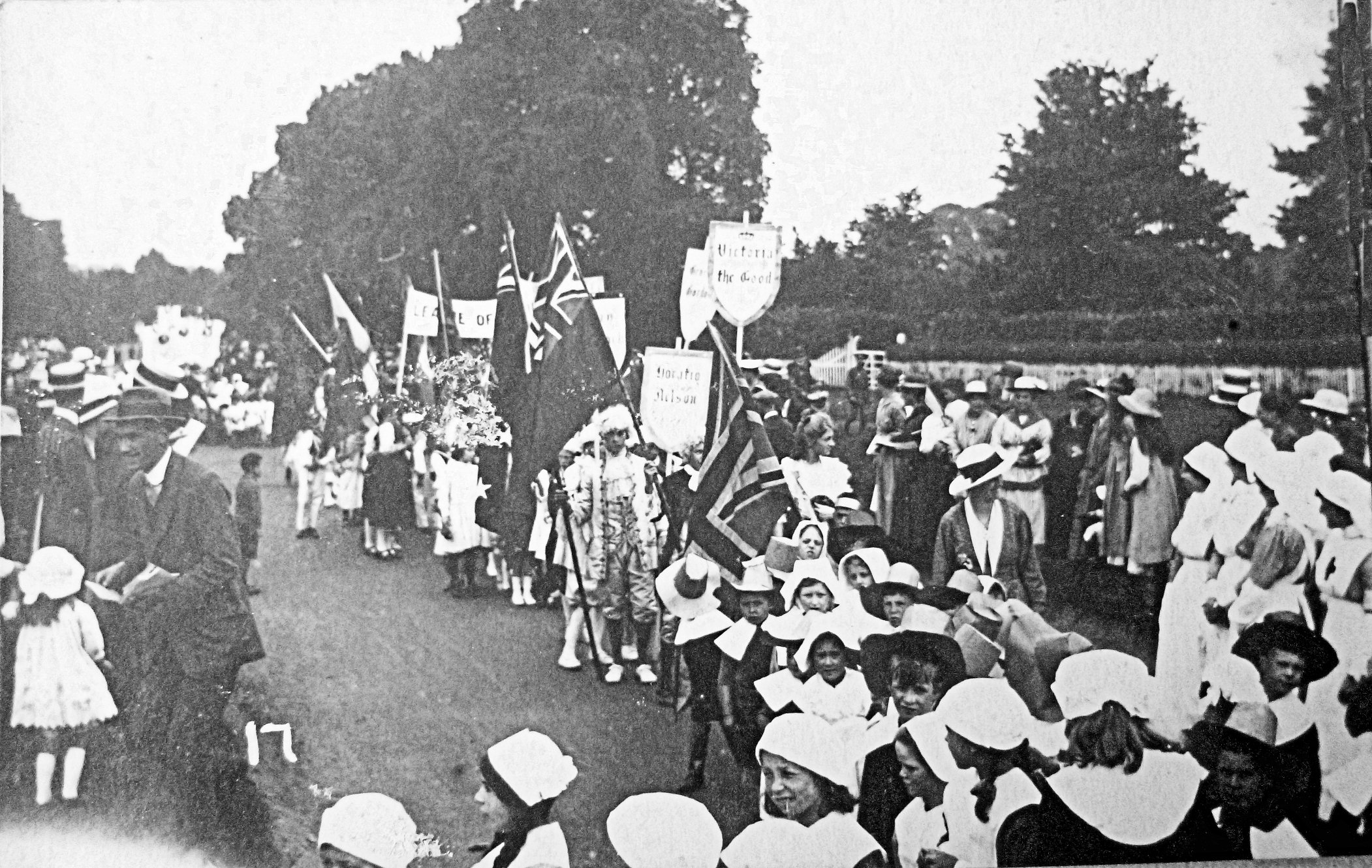
The Peace Day Parade, 19th July 1919, somewhere near Rickmansworth
Louise has kindly supplied a digital copy of this interesting postcard, which I have added to the Rickmansworth pages of the main web site. Can you identify any of the children in the foreground?

If you have similar old postcards or original photographs relating to Hertfordshire relating to the First World War or earlier it may be possible to share them on the Genealogy in Hertfordshire web site.

Sunday, January 21, 2018

Changing Comic Post Cards when the First World War started

When the First World War broke out there was a rush of new post cards which showed our soldiers in a good light. 

But there was a problem in that in the years before the war there were "comic" post cards which painted a less favourable view of our armed forces. 

The answer was to redraw and reissue the cards to show things as they were now that our gallant men were fighting at the front.


Note - If you could only afford one domestic servant she did all the jobs around the house and was often referred to as "The General."

Wednesday, December 13, 2017

Detailed account of the Death of Lieutenant Colonel A C Gordon

Hemel Hempstead Gazette, 22nd December, 1917
The Battle of Cambrai
... ...
While the 235th Brigade was supporting the Guards Division, the 236th  Artillery Brigade, under Lieutenant Colonel A. H. Bowring, were allocated to help the 20th Division on the Welsh Ridge in the neighbourhood of La Vacquerie.

Over the next week the Germans shelled indiscriminately in the area, including Havrincourt Wood. They killed a mess carthorse on 8th December, while the A/235 Battery lost two horses killed and three men wounded on the 10th, and the wagon lines moved to a safer position at Fins. On the 12th there was a major regrouping of artillery and the C.R.A. war diary records that “The Divisional front is from 4 p.m. today covered by one Field Artillery Group, under the command of Lt. Col. Bowring, consisting of 77th (Army) Brigade R.F.A. and 235th  and 236th Brigades R.F.A.” The war diary also reports that there was very little hostile fire with “only a few rounds on Havrincourt and our trenches.” Unfortunately, half an hour after the regrouping of the Divisional artillery one of the few shells to fall on Havrincourt that day found a target in the B/235 Battery position. Captain Pilditch recorded what happened in his diary:
December 12th. ... I was just going comfortably to bed when a message came from Brigade to say that Colonel Gordon had been killed and Major Hatfield badly wounded. It was a great shock, the worst I’ve had since Gorell’s death, especially as everything seemed reasonably quiet in front and we had had no casualties to speak of since we came into action here. It was not so much surprise at a Colonel being overtaken by the fate more commonly reserved for gunners and subalterns, (a year of Ypres had scattered all illusions and put us all on a level as far as that was concerned) but Gordon was certainly a man whom one unconsciously thought of as one who goes on and prospers and is not killed. He has done splendidly during the last week as C.R.A. to the artillery covering the Guards, and after ten days’ momentous action with so few casualties in our immediate circle, one had, as so often, become lulled into a false sense of security and hardly gave a thought to the tragic side of war. Now that pleasant illusion was shattered. The two senior officers of the Brigade had been hit, Hatfield was reported very badly wounded, and the Doctor [Hebblethwaite] had had a miraculous escape. It could, we felt, have been quiet on our front, but it was a reminder, as in the case of Kimber, and again when Gorell was killed, that on the quietest, sunniest days, death lurks quietly unseen and unthought of, but never absent and never asleep, I felt very miserable for some days after this. Gordon was a fine C.O. and a good friend to our Battery and to me personally. I slept badly, thinking of Gordon and that the last important link with the old days was gone.
December 13th. ... Flynn rode back with me along the cord-wood road to Trescault for the funeral at Havrincourt. There were ten officers from the Brigade there. He was buried in a little graveyard by the side of the road [at Ruyaulcourt]. Eighty men and two trumpeters followed. As at all funerals I felt profoundly miserable. I think at such times most of us feel ‘which one of us will be the next?’  There is one thing, however, about deaths out here. There is too much action and work in one’s life to allow of much worrying and brooding over sad happenings. One man goes, another takes his place, and still the war goes on, full of vital interest and concern for the survivors. We shall, I expect, those of us who are alive when the war stops, feel the deaths far more then than now. Also, I think, we feel that a proportion of us (in the Infantry a majority) will soon pass the same way, and the consciousness that it is but a step forward is stronger, here and now, than in the piping times of peace. So after the funeral, at which we all felt very miserable, we came back to our pigsty billet and had a good dinner and cheery game of bridge and personally I slept like a log. Gordon is not forgotten but God is merciful and blunts the edge of these sorrows while we have other hard things to bear.
The Brigade Chaplain wrote a letter of condolence to Gordon’s widow, Irene, which, in the light of Pilditch’s diary and General Fielding’s letter, seems more genuine than many which were sent to grieving relatives:
He was one of the finest commanding officers that any brigade could have. He had all the qualities which go to make the ideal leader of men, and they would have followed him anywhere. He died just after the accomplishment of the greatest achievement in his military career, having done something with his brigade which it is given to few artillery officers to be able to do. His name has been on everybody’s lips in this division, and not in this division alone. Further honours would certainly have come to him in the near future. I have known him for over two years now, and I have lost a much respected and large-hearted friend. I shall always remember him as one who inspired, by his example, the boys and men whom he led (and whom I have worked among and love) to achieve things which seemed almost impossible.
The news soon reached Hemel Hempstead, as one of the gunners formerly billeted in the town wrote with news from the front on 15th December:
We are now billeted in a village, which our boys have named “The Better Hole” on account of its being but a heap of ruins. I regret to say we have lost Colonel Lowe, who had been made a Brigadier-General, and was posted to another Division. He had been there only a month when a piece of shrapnel pierced his lungs. ... Lieutenant Colonel Gordon, D.S.O. was also killed a few days ago. No doubt you will remember him when he was at Hemel Hempstead. He was Major at that time. Corporal Gilman  was also wounded this morning but not very badly. He used to be in the Battery office at the Manse [in Alexandra Road] in the old days.
The London Gunners Come to Town Chapter 23, pages 199-201

The London Gunners Come to Town describes life in a Hertfordshire market town [Hemel Hempstead], its overnight transformation into a garrison town, and the war’s impact from three very different viewpoints. ... ... "The Soldier's Tale" describes life in the town, and military training in the surrounding countryside, as recorded by the soldiers at the time. To emphasize the reason why they had come to Hemel Hempstead, the book briefly follows the military career of Major Gordon of the 2nd London Division (later the 47th Division) on the Western Front. The battle of Loos is described by men from the town. The book also reports on the local men who joined the Hertfordshire Regiment and marched out of town in August, 1914

Friday, December 8, 2017

WW1 Book: We're Going Right There (Hertfordshire Regiment)

"We're Going Right There" by Duckboard
I got this well-written book some time ago, and when I read it I forgot to post a review on the Genealogy in Hertfordshire web site. As copies are still available on ebay it could make an excellent present for anyone whose ancestor fought with the first wave of the Hertfordshire Regiment to go the France during the Great War.


Additional information on the Hertfordshire Territorials


Thursday, August 17, 2017

Dan Hill's Talk on the Hertfordshire Regiment


Last night Dan Hill, of the Herts at War group gave a most informative talk on the role of the Hertfordshire Regiment in the First World War. In particular he gave a detailed analysis of the events at St Julien on 31st July 1917, during the battle at Passchendaele. After the unsuccessful attempt to break through the German lines every officer, and 75% of the men were dead, wounded or missing. He also spoke about the erection of a war memorial on the battle field on the 100 year anniversary of the battle.

His talk ended with a very interesting film of the Hertfordshire Regiment in camp in October 1917.

It should be noted that the Herts at War group plan further talks on the First World War and details will be posted on their web site, if you are note already on their email list.

Monday, August 14, 2017

The Rothschilds and the RAF Connection


Halton House - The Seat of Alfred Charles de Rothschild
In the 19th century the Rothschild family family settled in the Vale of Aylesbury - extending into Hertfordshire in the Tring area. One of their slpendid houses, built by Alfred Charles de Rothschild was at Halton, just over the county boundary into Buckinghamshire.

When the First World War broke out Alfred made his couse and grounds available to the army. The initial army camp was used to train soldiers in Kitchiner's new army, but soon became a base for what was to become the Royal Air Force.

There will be an open days on Sunday 10th September between 10 am and 4 pm. Halton House (now the Officers Mess, RAF Halton)  will be open  providing a rare opportunity to see the interior of Halton House, built by Alfred de Rothschild in 1883, a lasting reminder of Victorian decorative taste.In addition a  shuttle bus will run between Halton House, the Trenchard Museum, (where more can be learnt about the history of the RAF Station and RAF’s Apprentice Scheme), and the James McCudden Flight Heritage Centre.  Transport will be provided between Halton House and the reconstructed First World War trenches.


Further details about the house can be found at http://www.haltonhouse.org.uk 


Wednesday, August 9, 2017

German POW at Hemel Hempstead & a link with Florence Nightingale

Cemmaes Court in 1897
In my book, The London Gunners come to Town I mentioned that after the war Cemmaes Court had been used to house German prisoners of war.

I have now had a request for a picture of the house and decided to find out more about it and who lived there.

It appears to have been built as a retirement home for Dr James Vaughan Hughes - who had been Surgeon Major in the Crimean War - and not only treated Florence Nightingale when she was ill, but was nursed by her when he was ill.

The information I have on Cemmaes Court has been posted at
If you can add anything about the history of the house, and particularly if you can provide a photograph of it I will be very grateful.

Saturday, July 8, 2017

WW! War Memorial at Tring - Information wanted

Ian Pettigrew asks "Whether any of your readers has any information about any of the individuals listed in the WW1 section of Tring Memorial.

He has put the developing piece of work online so you can see what he has already done. If you have any information, including relevant family photos and memorabilia, please let him know at webmaster@gerald-massey.org.uk 

Monday, March 20, 2017

Spring Issue of Herts Past and Present

The Spring 2017 issue of Herts Past and Present has just been published by the Hertfordshire Association for Local History.

As always it contains an interesting collection of articles

Hertfordshire men at Passchendale, 1917, by John Cox
In search of "My Lord" Salisbury, by Nicky Webster (about researching and publishing the life of James Gascoyne-Cecil, 2nd Marquis of Salisbury)
William Cecil, 2nd Earl of Salisbury - The Education of a nobleman, by Alan Thomson
'Plenty of Punch and Good Company' - Bringing local history to life about a theatrical production dramatizing the life of John Carrington, farmer of Bramfield
The Enclosure of the Manor of Barnet, 1818, by Susan Flood
Local History Essay Competition - with details of essays on Knebworth, Lemsford and Croxley Green
Report of the 2016 HALH Symposium on Hertfordshire at war through the centuries.
Book Reviews: Watford : A History, by Mary Forsyth; St Albans: Life on the Home Front, 1914-18, edited by Jonathan Mein, Anne Wares and Sue Mann; On Hertford and its Environs: A Portrait in verse of Hertford and the Surrounding Countryside, by Thomas Green (1719-91), edited by Jean Purkis and Philip Sheail.
Dates for the Diary
13 May  - HALH Spring Meeting and AGM, Ware
24 June - Summer Visit, Benington Lordship, Benington
11 November - Symposium: Women of Hertfordshire, Hitchin

Tuesday, October 11, 2016

First World War: The Home Front at St Albans


Members of the St Albans Arc & Arc Society's Home Front Project Group have arranged for a pop up stall to be set up in St Albans Central Library on Wednesday 19 October. The aim is to give members of the public the opportunity to chat with the group about our new book, St Albans: Life on the Home Front, 1914-1918.


Herts at War - Salonika - Talk 19th October


The next "Herts at War" talk about the involvement of the Herts Regiment in the Fisrt World War is on "Salonika" on 19th October It is being given by Alan Wakefield who co-authored the book Under the Devil’s Eye: Britain’s Forgotten Army at Salonika 1915-1918 for Sutton Publishing. He is currently working with photographs at the Imperial War Museum.

Thursday, September 22, 2016

A woman turns to butchery during the First World War

This picture appeared in the press (source unknown) in 1916.

I am sure that there were dozens of other women in Hertfordshire just like her, wielding a meat cleaver to keep the family business running.

It would be wonderful if anyone could identify her - but I suspect this will just be another example of a portrait without a name.

A reminder - are all your precious family pictures clearly labelled so that future generations know who they are. There are millions of photographs from this period which show people who have been dehumanized by having become nameless.