Showing posts with label Census. Show all posts

Saturday, November 12, 2016

The Census Enumerator strike back

19th November

The Enumerator Strikes Back
(A look at the census enumerator's work)
by David Annal

Talk starts 3 pm at the Woolmer Green Village Hall

Friday, October 30, 2015

The 1939 National Register is coming ...

Census
In September 1939 the government produced a register in order to issue National Identity Cards during the war, and the register was later used for rationing and even later as the basis for the registration for the National Health Service. The register records name, address and occupation and is important because the 1931 census records were destroyed during the war, and no census was held in 1941 because of the War,  (The 1921 census exists but is not due to be released until 2022, and the 1951 census will not be released until 2052)
The 1939 register has been released for publication in digitized form and will be available from 2nd November on FindMyPast. I expect the service will be overloaded over the first few days but look forward to looking at my own record, which should show me living in a shop in Swain Street, Watchet, Somerset, as my parents had moved from Hertfordshire a few months earlier.
How to Search the Register

If you use it to find something interesting about your Hertfordshire ancestors why not post  details as a comment below.

Thursday, March 12, 2015

The 1939 Register will be coming online

Census returns
Because of the 100 year rule the 1921 census will not be available until 2021. The 1931 census returns were destroyed in the war. There was no census in 1941 because of the war and I do not expect to ever see the 1951 census which will not be available until 2051. However in 1939 there was a register of all people living in this country which was used as the basis or war time identity cards - and the later National Health Service registration numbers.

The following announcement has appeared on the FindMyPast web site:
In 1939, on the eve of World War II, the British government introduced an act that would allow them to gather vital information about the country’s population. This information would inform their decisions on identity cards, rationing, conscription and more, including – eventually – the formation of the NHS. In 2015, for the first time, Findmypast in partnership with The National Archives are publishing the 1939 Register online, providing an unprecedented insight into a country on the verge of war.  We’re currently in the process of digitising all 7,000 volumes that contain the 40,000,000 entries that make up the 1939 Register. We'll be updating regularly on our blog and social media on how that process is going, so stay tuned
Looks interesting for those researching the last 100 years - but for the time being at least this site will be concentrating on local and family history before the end of the First World War. 
!

Monday, June 30, 2014

Genealogists' Magazine - June 2014

Because this magazine, the Journal of the Society of Genealogists, covers a very wide field this issue has no articles directly connected with Hertfordshire - but two could be of interest to readers of this Newsletter.

The Loyalty Oath Rolls of 1723: an early census, by Sylvia J Dibbs, is a useful article on the history of these documents. It includes a reference to the web site History Working Papers - including a list of all the known surviving copies. Hertfordshire has a surviving roll which includes over 6000 names. While the site does not include these names they have been recorded in Hertfordshire County Records:  Volume VII, ed. W. Le Hardy (Hertford, 1935), pp. 477-563 - which is available on CD (Archive CD Books).


It is an Illegal Date, by Robin Bailey, provides good reasons for looking very carefully at the dates you find in parish registers around 1752. While you may be aware the when the calendar was changed there were 11 missing says in September 1752 - but the change stared the day after 31st December 1751. The change in the law meant that the next day was 1st January 1752 - which must seem obvious to us now - but if the change hadn't happened the next day would have 1st January 1751. What the law did was to change the start of the year and in England 1st January 1751 to 24th March 1751 never existed. However changing the law does not mean that people understood the change and mistakes "carrying on in the old way" can often be found in original registers, sometimes for several years. The lesson is to check the individual register entries (and noy just the one affecting your ancestor, to see if the minister got the year wrong!

Saturday, May 24, 2014

Researching a 19th Century St Albans Fishmonger


St Albans

Help Desk
In sorting out this family of 
for Lilian one of the key issues was in understanding the way relatives are sometime (mis)described in census returns.

Thursday, April 3, 2014

FindMyPast have put their foot in it ...

I have been so busy recently I haven't had time to do much online searching - so this morning I visited the reformatted FindMyPast web site. I decided to try out a few things and superficially the site looks better, and gives the impression of being more friendly. I carried out a number of searches and definitely one of my deliberately "awkward" searches was much better. My first impression of the newspaper searching was that while the search algorithms were exactly the same the user interface was better.

Some of the other search interfaces were easier to use for noddy queries - but as soon as I started to ask real questions serious drawbacks emerged, and the number of messages pointing out what is a serious redesign error suggest that many people will not be renewing their subscription. I have posted the following message on their forum under "SEARCHING"

First let me say that the old site needed a face-lift - and on the technical side there have been some real improvements. Of course many people will not like change - even if it is for the better - and at least some of the comments I have seen fall into this category.

I started using computers for family history research in 1977 and gave a talk at the first ever meeting of the Computer Group of the Society of Genealogists. However I switched to local history studies (often linked to the family) when I retired. Before I retired I actually taught Human-Computer Interaction techniques, and you appear to have fallen into a common trap of thinking that the key to a good computer system is technical expertise. Too many people think that employing computer geeks who know all there is about scripting web sites is vitally important. (Most computer geeks are what they are because the are better at interacting with computers than with fellow human beings.) In reality what you really need when you are (re)designing a system is someone who really understands users and what they want to do and if you give them what they want they don't really care about all the bells and whistles ...

I currently use your system regularly for local history studies - I am interested in the people who live in an area, what they do, and how they interact. For instance I am currently looking at the Victorian Photographers in Hertfordshire and I am not only interested in family relationships but also business links - such as where a particular photographer learnt their skills - perhaps as an assistant for another photographer - or perhaps their father, or a close relative, was a portrait painter. ... ...

The apparent failure to be able to search for census occupations in the new system is an absolute disaster. In addition the loss of a complete transcription listing of a household seems to have no technical justification (presumably some computer geek thought it would be tidier) but means that people will have to waste more of their own time and your computer's resources repeatedly asking questions about other members of the household.which could have been provided in less than a milisecond. (I am well aware that in some cases it may be necessary to restrict questions to optimise load on a very busy computer - bit this is not one of those cases.)

In any case, if you want to encourage people to research their ancestors - or local history - providing the whole household can excite people to ask more interesting questions - because they see detail of the other people in the house and ask "I wonder why ....?"  Perhaps the change was made because you were trying to ape a competitor's site - when in fact the other site was worse than yours - and people were using your site because the way you did it in the past was more helpful. Definitely that was the main reason I normally use FindMy Past for census searching.

The problems the new site demonstrate suggest that you did not have a well chosen and varied panel of genuine uses at the early design stage.  Maybe you made the changes because of complaints - failing to realise that these exclude the views of the majority of satisfied customers - or perhaps you ran a market survey with inappropriate questions. Viewing the storm the changes have caused you need such a panel PDQ.

I am sure they will be making more changes - and I will reassess the site later in the year to see if they have improved. I am almost certain to continue my subscription because the site has the Hertfordshire parish registers which are not available elsewhere, and one also has access to the British Newspaper Archive.

Comments on you own experiences of the changes would be welcome.

Friday, August 30, 2013

Stupidity at FindMyPast with the 1911 census (How they correct errors)

While researching the photographer Thomas Latchmore I came across the following 1911 census transcription in which the first line looks decidedly odd.

So I looked at the image and found

It is clear that the first line of the transcription is totally wrong - apart from the surname not one field is correct. Like all commercial transcriptions speed of getting the product to market meant that accuracy suffered (to be fair FindMyPast is NOT the only culprit in this respect) but at least FindMyPast does have a means of correcting errors. So I reported the fault (reconstructed image)

Read on to find what happened

Sunday, August 25, 2013

Exploring the History of Hastoe House, near Tring.

The Account Book


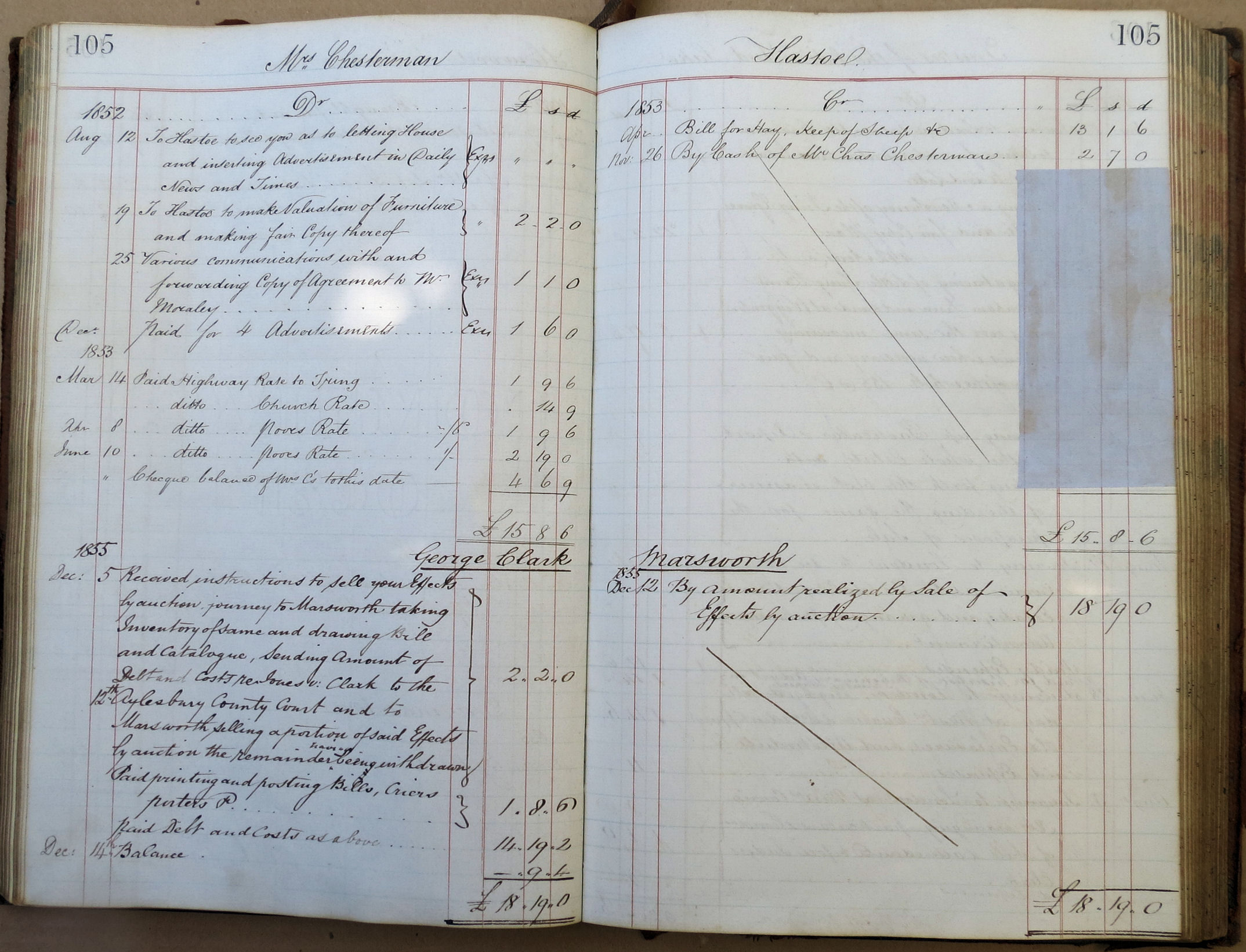
Folio 105 of William Brown's Account Book  records that a Mrs Chesterman asked him to let Hastoe House and value some furniture.

Why?

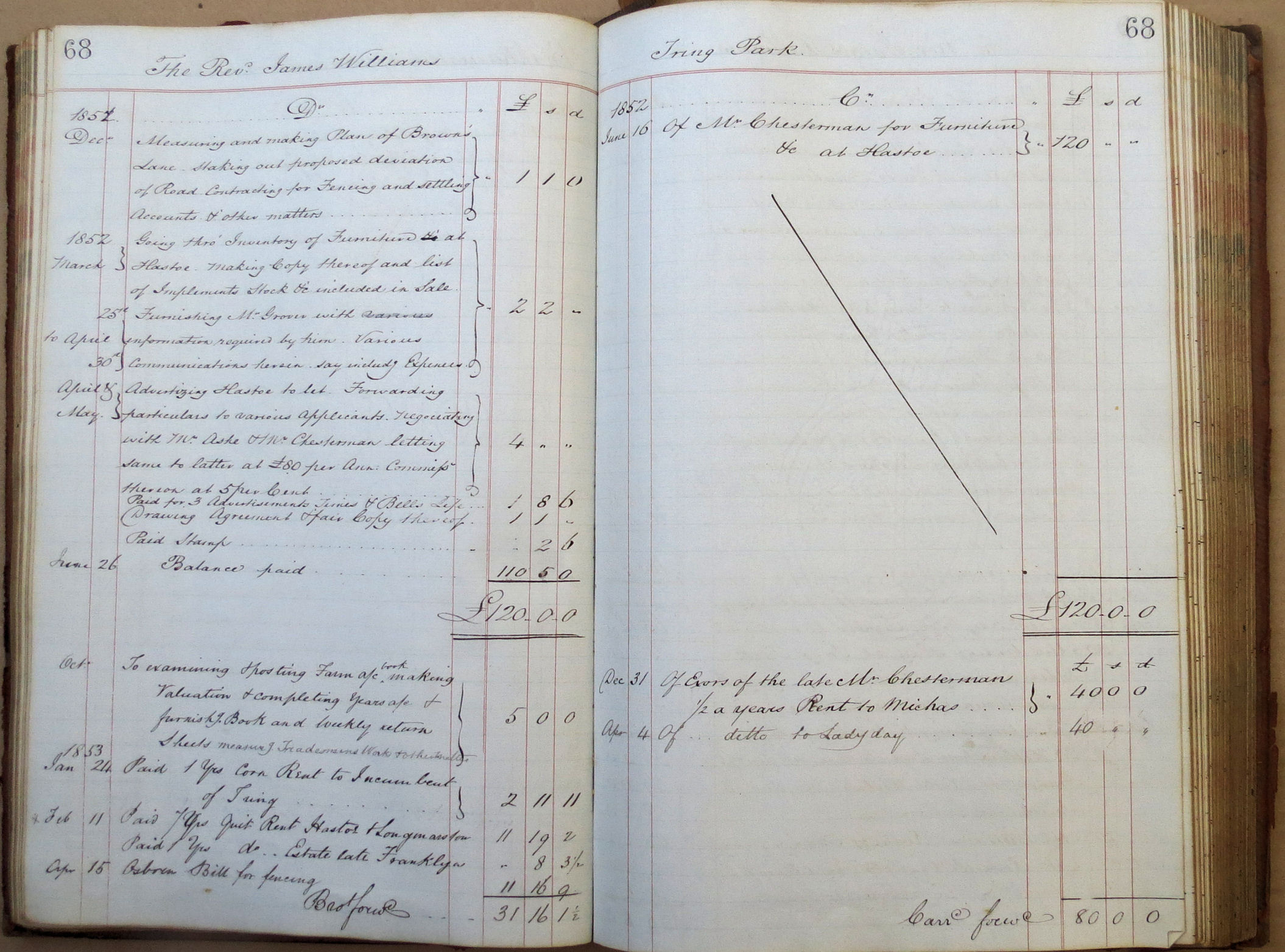
William Brown also managed the property affairs for the Rev. James Williams, who lived in Tring Park. Folio 68 shows that in April 1852 the house was advertised to let. In May Mr Chesterman agreed to rent the house at £80 per year and on 16th of June Mr Chesterman brought the furniture in the house for £120. Ubfortunately he died on 1st July, 1852 - so clearly did not have much time to enjoy Hastoe House.  William Brown's Account Book shows that the Chesterman executors continued to pay the rent until 1856 so I decided to see what happened to Mrs Hannah Chesterman - only to find that in 1853 she married William Brown's brother James!

I was hooked - and I decided to see what I could find out about the other tenants. This was made possible because all the 19th century editions of the Bucks Herald (published in nearby Aylesbury) are available on the British Newspaper Archive. A certain amount of intelligent deduction was needed - helped by the fact that Hastoe House was the only property in the Hastoe area which was posh enough to employ resident domestic servants. 

The many tenants included Baron Rothschild in 1843 (he probably used it as a hunting lodge), the son in law of the Bishop of Chichester, a "retired squatter" (not what you might think), and William Brown's business partner. It seems that another tenant, a William Burns, died shortly after taking the tenancy. The only significant gap between 1841 and 1901 is that I was unable to discover the name of the tenant who was resident at the time of the 1861 census - as only their domestic staff are recorded.

For full details, including copies of the relevant sections of the account book, various press adverts, maps, and two modern views see CHESTERMAN & Hastoe House, Tring, circa 1838 - 1901
It should be pointed out that it was possible to find so much out, comparatively quickly, because Hastoe House was the only "gentry" accommodation in Hastoe, which itself had a very small population. 

Saturday, July 20, 2013

Why not help others with their Family History Research

Most of you will probably know and use FreeBMD because of its excellent coverage of the Birth, Marriage and Death register indexes - which have been constructed by socially aware family historians who wanted to help others. Coverage is almost complete from 1837 to 1960. In May 2013 it contained 229,076,495 distinct records, and on one day in June was searched 145,484 times. Volunteers are still needed to help complete the work.

FreeCEN
FreeReg
FreeCEN aims to provide a similar service for the census, and FreeReg for the parish and non-conformist registers. However in both cases the coverage of Hertfordshire is small and volunteers are needed. 
So if you are retired and want to do something useful helping others why not volunteer today.

Monday, March 11, 2013

Things aren't always what the census appears to be telling you

Help Desk
Railways
Michael Meredith was one of the railway works employed in at Tring railway station at the time of the 1851 census, and a few years ago Carlene asked for more information about him and revealed that he had emigrated to New Zealand and had been murdered in 1863 - their murder being a tipping point in one of the Maori Wars. I provided more information, from the 1841 census and noticed that Michael's eldest daughter had not been at home in 1851 and I could not find her anywhere in the 1851 census.

Sunday, January 13, 2013

Census Humour - Who was Diddy DADDILUMS?

Census returns
I found an old page discussing Census Humour while reformating pages for the new picture buttons and it set me thinking. ...


The first full census to come out in digitized form was the 1881 census (on CD), although some local censuses (for instance the 1851 census for Berkhamsted and St Albans) had appeared in print. At that time several people reported returns which included fictitious people or inappropriate occupation descriptions which suggest that the house occupant was taking the mickey out of the census enumerator. 

One of these was Sampson J RUMBALL, who was living at Townsend Farm, St Peters, St Albans, and his live-in staff included a governess teacher, cook, domestic servant, nurse and attendant.

The "attendant" was 7 year old female  "Diddy Daddilums", who had been born in St Peters, Hertfordshire, and  the census enumerator had added "(DS)" - so that "Diddy" would be recorded in the census totals as a domestic servant.
I first posted details of this entry online in 1999 and I strongly suspect that "Diddy Daddilums" was the affectionate name of the family dog!

Now the opportunity for such records was reduced because the surviving 1841-1901 census returns were extracts made by the census enumerator who would have had to copy the original returns from the household forms (which have not survived) into the census books (which have) and who may will have censored obviously silly entries.The 1911 census is different. We have the actual household forms - so we know exactly what the householder recorded. Has anyone come across 1911 entries (preferably with a Hertfordshire connection) where, for example, it seems likely that a family pet has been included in the returns? Or perhaps you have found some other entry where the form was deliberately incorrectly filled in - and perhaps "silly" entries crossed out?

Wednesday, January 2, 2013

Where in Hertfordshire is it - Barnville Wood?

Maps
Harpenden
Jacky's question was, perhaps, easier than some as errors such as "rn" and "m" being confused can occur in print as well as in handwriting - and once you have discovered Bamville Wood is near Harpenden it is easy to locate the farm where Alfred Thomas White was living in 1911. 

If you are trying to find where your ancestor lived you may find the approach I used in Bamville Wood, Harpenden, 1911, or the more detailed Locating Census Addresses on Maps, helpful.