Showing posts with label Parish Registers. Show all posts

Sunday, June 14, 2015

A Note on Hertfordshire Parish Graveyards


Grave boards at Ayot St Lawrence from a postcard published circa 1905.

I frequently get requests from people who have discovered that their ancestor was buried in a particular parish and are planning to visit - so a brief summary of what they might find is appropriate.

Before about 1800 nearly all burials would have been marked with wooden grave boards, such as the above examples, and some were still being used a hundred years later. Typically after 50 year the wood would be rotten and for many centuries the grave would have been renewed. The very few graveboards that remain will be completely unreadable unless they have been renewed. 

While a few late 17th century grave were given headstones they typical materials used in Hertfordshire mean that often it is not even possible to see if there was an inscription. During the 19th century the use of gravestones became common - and in most of the towns the churchyards fill up and town cemeteries were opened - and burials ceased in the church graveyard. 

Maintaining a graveyard full of stones of the long deceased can be an expensive business and many church graveyards have been tidies up - particularly in towns. This may (if you are lucky) means laying the stone flat - inscription up - so it can be mowed over. In other cases stones are leaned against the churchyard wall, used to make paths (and in one case I have seen the walls round a compost heap) or taken to the tip. - Some 50 years ago I was horrified to find that the beautiful pink granite slab on one of my great great grandfather's tombs had been scrapped in this way.

So if you are planning a visit be sure to check the burial register (at HALS or online at FindMyPast). Find out if the Herts Family History Society have indexed what is left. It can also help to look for online photographs of the church (Google satellite or street views, Geograph, etc) to see if any tombstones remain.

Parish Registers
Further advice on family events is available on the main web site - although some has not yet been updated to include the latest online sources.


Sunday, June 15, 2014

Are there hidden gaps in parish registers?

Help Desk
Colin's question about the birth places of the Rev. Thomas Charles Hose looked straightforward enough - but when answering a question other unexpected issues come up.

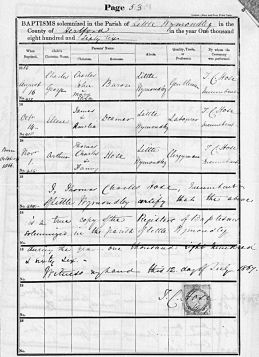
 On the 1st November 1866 Thomas baptised his son Arthur at Little Wymondley and the entry in the register is followed by the words:  
I, Thomas Charles Hose, Incumbent of Little Wymondley certify that the above is a true copy of the Register of Baptisms solemnized in the parish of Little Wymondley during the year one thousand eight hundred and sixty six.
Witnessed my hand this 12 day of July 1867
J.C. Hose 12/7/67
So what was going on? The register was meant to be the master record of baptisms in the church - so why is this "a true copy of the Register of Baptisms" ??? The most likely explanation is that Thomas had been keeping a private register rather than enter the baptisms directly into the official register, and had, in July 1867, copied the entries over.

This raises a possible source of error in baptismal (and burial registers). When a wedding was held (at least after the Hardwicke Marriage Act of 1753) the register had to be filled in at the time because the register needed to be signed by the couple and witnesses. The register is not needed at a baptism or burial service, but is completed afterwards. Not only could the minister forget to record it - but it seems that a number of ministers wanted the registers to look neat and tidy and wrote the details in a private notebook and entered a whole batch of entries at one time. This practice opened the possibility of all kinds of additional errors and omissions - especially when the minister died before he could update the register.

Little Wymondley
In the case of Little Wymondley the patronage arrangements had changed in 1863 and prior to this date there may have been an unofficial parallel register. (Further investigation is needed as while FindMyPast shows individual pages of the register it does not allow scrolling through for unusual entries or patterns of entry.)

For more information - including details of Thomas Charles Hose and his family - READ ON ...


Saturday, July 20, 2013

Why not help others with their Family History Research

Most of you will probably know and use FreeBMD because of its excellent coverage of the Birth, Marriage and Death register indexes - which have been constructed by socially aware family historians who wanted to help others. Coverage is almost complete from 1837 to 1960. In May 2013 it contained 229,076,495 distinct records, and on one day in June was searched 145,484 times. Volunteers are still needed to help complete the work.

FreeCEN
FreeReg
FreeCEN aims to provide a similar service for the census, and FreeReg for the parish and non-conformist registers. However in both cases the coverage of Hertfordshire is small and volunteers are needed. 
So if you are retired and want to do something useful helping others why not volunteer today.

Sunday, July 7, 2013

Hertfordshire-related updates on FindMyPast (Registers and Newspapers)


BMD
Newspapers
FindMyPast has announced that nearly 2 million new Hertfordshire register records have been added to their collection and list the current holding at http://www.findmypast.co.uk/content/news/hertfordshire

As usual they do not list the changes so there is no list that you can check to see what had changed that will affect your own research since last time. As is common with many other systems they are reluctant to tell you that a search was negative because the relevant records were not online or not indexed. If you search for my grandfather, by father, and myself in the Sandridge register, you will only find my father, who was baptised in 1908. You are given no reason for the other missing entries but a look at the list shows that the parish baptisms have been indexed between 1898-1910. Further investigation shows that the online images come from a register that runs from 19th June 1898 (on page 1)  to 5th May 1935 (on age 100). So baptisms in 1901 before 19th June 1908 are not indexed, while baptisms after 1910 are online as images - but not indexed. What is more the original register has been manually indexed by surname on the front cover (image opposite Page 1) and back cover (image opposite page 100).

The list of parishes shows Sandridge Marriages indexed between 1898 and 1901 - but I could not find a single example from the register so have no idea what, if any, has been indexed. In fact the Banns are indexed for a much longer period, including the years 1898-1901, proving that weddings did take place during this period. There are no Sandridge burial registers yet online. If you are interested in a particular village you will need to check what is (or is not) online with care.

The newspaper collection  now contains nearly 7 million pages, but the June updates did not include any papers relating to Hertfordshire. The most relevant papers already online are:
Bucks Herald 1833-1909
Cambridge Chronicle and Journal 1813-1871
Cambridge Independent Press 1839-1913
Chelmsford Chronicle 1783-1950
Essex Standard 1831-1900
Hertford Mercury and Reformer 1834-1868
Herts Advertiser 1925
Herts Guardian, Agricultural Journal & Advertiser 1852-1867
Luton Times and Advertiser 1856-1914
As can be seen the coverage of Hertfordshire is poor. Nothing from places such as Hemel Hempstead, St Albans (apart from one year for just one of the many papers published in the town at various dates) and Watford, with nothing from Hertford after 1868.

Saturday, March 9, 2013

Shadrach, Meshach and Abednego at Tring 200 years ago

Help Desk
Family Events
Two hundred years ago Tring was a hot-bed of non-conformity, which has the unfortunate effect that there are no birth or baptism records for many children. However most people still got married at the parish church before 1837 and were buried in the churchyard - as most chapels did not have their own burial grounds. I was looking for a suitable test problem to try out the Hertfordshire registers that are now available on FindMyPast and a comment by Melvyn Barber gave me just what I was looking for.

Tring
There is no doubt that his great great great grandfather, Thomas Barber, was born in Tring around 1828, but  he was born before civil registration (1837) and there is no surviving evidence of his parents. Looking at the marriage records for Tring - and the early census returns revealed an interesting family. It is not clear who the couple were but they named their sons Shadrach, Meshach and Abednego, after the three people that God is said to have saved from the fiery furnace. The matter is complicated by the fact that Thomas's father, Meshach died before the 1841 census and his wife remarried, but information from post-1837 marriages name the father, and a single "emergency" baptism of a new-born child who died within days, provided further evidence.  For the full story see BARBER, Tring, early 19th century.

Sunday, February 24, 2013

Hertfordshire Parish Registers now online

Parish Registers

Findmypast.co.uk has published online Hertfordshire records dating from 1538:
Jolly good as far as it goes - as we have been waiting for this for over a year - but when I checked my Aunt's baptism in 1895 I found a bad transcription error - a very clear "Finch" was indexed "Frank" - and, unlike the census returns, FindMyPast has provided no way of submitting amendments. 

I also found that for the parish I am most interested in, Sandridge, the amount covered is very limited - Baptisms 1898-1910; Banns 1824-1928; Marriages 1898-1901; Burials None. Other parishes seem better.

Interestingly if you select a Sandridge baptism for 1910 and view the register pages - you can scroll forward into 1911 and perhaps beyond but these are not indexed. In fact the software tells you that the baptism after 1910 for Sandridge is not found without telling you this is because it is not indexed.


I don't have time to do a detailed survey at present so if you try the new records why not add a comment below as to what you find to help other people find their way round the new facility.

Friday, September 28, 2012

Some Middlesex Parish Registers - and why you should check old family trees


Earlier this year I reported that FindMyPast were planning to computerize some Hertfordshire Parish Registers. There is not sign of them yet but they have just announced that a number of Middlesex registers are now available online, and the following could be of interest to any of you who are researching across the county boundary.

Edmonton, Frien Barnet, Harefield, Little Stanmore, Monken Hadley

I don't have any relatives in these parishes but over 30 years ago I researched the Phipson family in depth. To test the facility I decided to see if any of them were recorded in any of the Middlesex registers that are now online. I found four children of a Joseph and Mary Phipson who were baptised at St James, Picadilly, between 1706 and 1718 that I had not known about. In addition a Sarah, daughter of Thomas and Elizabeth Phipson was baptised at St Martin in the Fields in 1735, and I had picked this one up in my original researches in the Society of Genealogists' Library using a microfiche of the International Genealogical Index (IGI). If Sarah's father is the Thomas baptised  in 1718 at St James my original family tree is wrong!  A peek at the Burials also suggests errors.

There is a lesson here. Old family trees were researched at a time when to get any information at all you had to tramp around records offices (and before that individual churches) and very little of the material was indexed.  It was therefore very easy to miss records, especially when your ancestors moved about so you didn't know which were the relevant parishes - and so errors could easily creep in. Modern research tools make it far easier to track people down - and to identify the errors in earlier research. So if you cone across an old family tree the first thing you should do is to look at the modern online indexes and documents to see if it is correct.