Showing posts with label Little Wymondley. Show all posts

Tuesday, January 30, 2018

Drunk in Charge in 1867

Drunken driving was a problem before the invention of the motor car, and the Victorian local papers often contain accounts such as the following, where Thomas Waldock apparently fell asleep while in charge of a donkey cart, leaving it blocking the road, to the annoyance of the Rev. John Johnson Tuck, of Wymondley. The resulting court case was reported in the Hertfordshire Express and General Advertiser of 11th May, 1867.

CORRECTION: Patricia has kindly drawn my attention to an error in my 2012 answer to a question about the Rev. John Johnson Tuck's school in Little Wymondley, where I incorrectly recorded the name of his mother. This has now been corrected.

Sunday, April 5, 2015

Pupils at the Rev Tucks School at Little Wymondley

Schools
The Wymondley House School is looking interesting. In 1841, when Tuck was at still at Welwyn,  one of the pupils was the Royal bastard George St George. Alison has found evidence that in 1851 one of the pupils at Wymondley House school was Hillier Gosselyn, who became mayor of Hertford on three occasions and also served as High Sherriff of Hertfordshire.  So did anyone else who attended the school under Rev. Tuck also become famous. I don't have time to check myself - but do any of you recognize any of the names of boys at the school in 1871 and 1881 - and what happened to them? 

Resident pupils in 1871: Eustace F Hill (13, London), Francis W Howe (12, London), Henry W Smith (12, Biddenham, Bedfordshire), Cecily E R Brise (12, Braintree, Essex), Valentine EdwardBeldam (11, Royston, Hertfordshire), James C Holloway (11, Stanhoe, Norfolk), Philip Bridges (11, China), Archibald Howe(10, London), Augustus S Orlaben (10, Willington, Bedfordshire), Eustace Guinness (10, Ireland), Lionel Herbert (10, East Indies), James Ward Beldam (9, Royston, Hertfordshire), Gordon H Paske (9, East Indies), Herbert A French (9, Shrandeston, Suffolk), Gerald S Guinness (9, Ireland) and Arthur H Gilbert (8, Hemsby, Norfolk).

Resident pupils in 1881: Oswald R. Mounsey (13. Sunbury, Middlesex), Arthur P. How (12, Sunbury, Middlesex), Francis C. French (12, Walingworth, Suffolk), Percy Clark (12, East Holthly, Sussex), George M. Graham (12, India), Charles G. Spencer (12, Wheatfield, Oxfordshire), Sydney How (11, Cobham. Surrey), Alexander C. Calvert (11, Maids Morton, Buckinghamshire), Herbert M.F. Rowe (10, London), Augustus F. Holman(10, East Hoathly, Sussex), Richard Noel Guinness (10, Ireland), William C. French (10, Worlingworth, Suffolk), Conwyn M. Jones (9, Beddington, Surrey), Randal H.W. Vickers (9, Cotham, Yorkshire) and Frederic L. Clarke (8, London).

The names and places of birth are taken from the census returns and there are certain to be some spelling and transcription errors. If you can identify anyone post your information as a comment.

Sunday, June 15, 2014

Are there hidden gaps in parish registers?

Help Desk
Colin's question about the birth places of the Rev. Thomas Charles Hose looked straightforward enough - but when answering a question other unexpected issues come up.

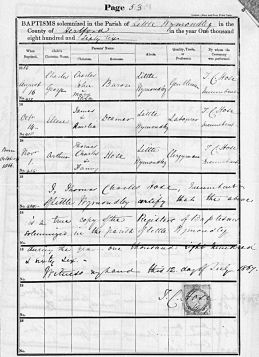
 On the 1st November 1866 Thomas baptised his son Arthur at Little Wymondley and the entry in the register is followed by the words:  
I, Thomas Charles Hose, Incumbent of Little Wymondley certify that the above is a true copy of the Register of Baptisms solemnized in the parish of Little Wymondley during the year one thousand eight hundred and sixty six.
Witnessed my hand this 12 day of July 1867
J.C. Hose 12/7/67
So what was going on? The register was meant to be the master record of baptisms in the church - so why is this "a true copy of the Register of Baptisms" ??? The most likely explanation is that Thomas had been keeping a private register rather than enter the baptisms directly into the official register, and had, in July 1867, copied the entries over.

This raises a possible source of error in baptismal (and burial registers). When a wedding was held (at least after the Hardwicke Marriage Act of 1753) the register had to be filled in at the time because the register needed to be signed by the couple and witnesses. The register is not needed at a baptism or burial service, but is completed afterwards. Not only could the minister forget to record it - but it seems that a number of ministers wanted the registers to look neat and tidy and wrote the details in a private notebook and entered a whole batch of entries at one time. This practice opened the possibility of all kinds of additional errors and omissions - especially when the minister died before he could update the register.

Little Wymondley
In the case of Little Wymondley the patronage arrangements had changed in 1863 and prior to this date there may have been an unofficial parallel register. (Further investigation is needed as while FindMyPast shows individual pages of the register it does not allow scrolling through for unusual entries or patterns of entry.)

For more information - including details of Thomas Charles Hose and his family - READ ON ...


Monday, September 10, 2012

Did your ancestor go to a private boarding school?

I have just had an question about the school that Paul's ancestor George FitzGeorge went to in 1851. He is uncertain about George's father and ideally he would like to find school records relating to his admission. Unfortunately the school was typical of the large number of preparatory boys boarding schools where there are no surviving school records. If you have a similar problem to Paul have a look at Rev. TUCK's School, Welwyn, Little Wymondley & Northaw, c1840-c1930 to see the factors I considered in trying to find more.

It is important to realize that it is likely that many of the pupils who went to the school went there because of personal recommendation - and might be relatives of the headmaster, or linked in some way to his family. For this reason I investigated the headmaster's family (including search online local newspapers) and also investigated a bit of the social background of the other pupils at the school in case there are any obvious contacts. The history of the school could also be relevant - as key documents may have been been kept when/if the school changed location or management. In this case the school may have been a continuation of an earlier boarding school  that was at Welwyn in 1839. In 1851/2 it moved from Welwyn to Little Wymondley. The school continued under a new schoolmaster and then moved to Northaw and the management changed again.Unfortunately the paper trail that school records might have followed goes cold in about 1935.

Thursday, September 6, 2012

Page Upgrades: Furneaux Pelham & the Wymondleys

As part of the slow but steady program of updating some of the older pages changes have been made as follows:

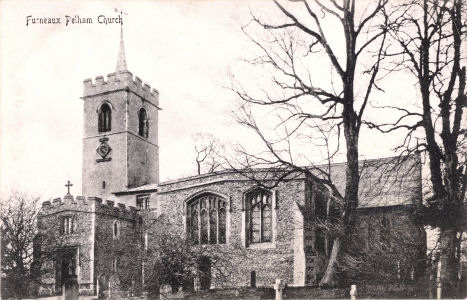
Furneaux Pelham: Page restructured to include a menu with extra external links, and two new pictures of the St Mary the Virgin on a dedicated new page

Furneaux Pelham Church
Great Wymondley: Page restructured to include a menu with extra external links, and an account of the village in 1903.

Little Wymondley : Page restructured to include a menu with extra external links, and some minor corrections to an account of the village in 1903