Showing posts with label Hertfordshire Association for Local History. Show all posts

Saturday, November 2, 2013

Traditional Building Materials in Hertfordshire - Symposium

I have just returned from the Herts Association for Local History Symposium which was held today at Abbots Hill School, Nash Mills, Hemel Hempstead. As always there were interesting talks, the opportunity to speak to people you haven't seen since the last symposium, and some interesting books on display - which will be covered later.

Before hearing Robin Harcourt Williams' talk on the building of Hatfield House - as I had not been aware of the extent of the surviving documentation relating to the manufacture of brick in the 17th to 19th centuries. Alan Thomson's talk on the unusual brick made by Caleb Hitch of Ware provided a very different insight into the brick industry in the county in the 19th century. From Peter Greener I learnt about clay bats - very large unbaked clay bricks used for walls and working buildings - while some houses were really little more the mud hutswhose walls needed to be protected from the rain. (Compare with the use of cobb in other parts of England.)

Other talks, such as Professor Martin Biddle's talk on floor tiles from St Albans Abbey, and Helen Gibson's on timber framed building, were enjoyable but of less relevance to this web site because they related to the medieval buildings.  As my parents lived in three different thatched cottages Colin Webb's talk on thatch was instructional and I was amused that many of his pictures were of "Pig's Nose", a cottage illustrated on my Buntingford page.

Saturday, April 20, 2013

Latest Issue of Herts Past & Present

Hertfordshire Association
 for Local History
The Spring 2013 Issue of Herts Past and Present has now been published and the articles in this issue are

  • Brief Guide to Sources: Vestry Minutes - by David Short
  • King Aethelred's land grant of 1 hide at Flamstead to St Albans monastry, 1005: Bounds centred upon Lybury Lane, Redbourn, by Victor S. White
  • Traditional Woodland Management in South-East Hertfordshire, by Peter Austin
  • The Role of the St Albans City Military Service Tribunal in the First World War, by Jonathan Mein and Anne Wares
  • Golf in Hertfordshire, 1890-1912, by Julie Moore

Wednesday, November 14, 2012

When was Football first played in Hertfordshire?

When was the first "football" match played in Hertfordshire? One of the problems is that the accounts that survive from the past often fail to mention the everyday activities of the ordinary people and football is no exception. The first description of what might today be called a football match was written by William FitzStephen in approximately 1170. While visiting London he noticed “after dinner all the youths of the city goes out into the field for the very popular game of ball.” He also pointed out that every trade had their own football team: “The fathers, and the men of wealth come on horseback to view the contests of their juniors, and in their fashion sport with the young men; and there seem to be aroused in these elders a stirring of natural heat by viewing so much activity and by participation in the joys of unrestrained youth.” Two centuries later a monk wrote that football was a game “in which young men ... propel a huge ball not by throwing it into the air, but by striking and rolling it along the ground, and that not with their hands but with their feet.” The monk claimed that the game was “undignified and worthless” and resulted in “some loss, accident or disadvantage to the players themselves."

Early in the 14th century Edward II banned the playing of football and several later monarchs took similar actions and we can be pretty certain that the game was played in Hertfordshire, but there are no early direct references to the game.

At the HALH Symposium on Sport in Hertfordshire David Short described a different approach - which was to try and track down old football fields by looking at old field names. He noted that a field in Ashwell listed in the tithe map was called "Football Close" and was able to trace the name to a terrier of 1628. Searching other similar records revealed another "Football Close" at Baldock mentioned in a 1568 deed.   However another term, dating back to Saxon times, may well indicate places where games such of football could have been played.  The name "Plaistowe" could well comes from the Saxon words for "battle place" and it would seem could be used for what we would now call a sports field. David found a "Plaistowe" in Hertford dating back to 1461, Another at Yardley dating back to 1630 and one is listed in Norton's Survey of Barley which dates to around  1600. In listening to the talk I got the impression that most were or the order of two acres and close to the parish church.

Monday, November 12, 2012

Report of the HALH Symposium on Sport in Hertfordshire


The 33rd Hertfordshire Association for Local History's symposium was held at St Edmund's College, Standon and there were some very interesting papers. John Pearson gave an enthralling talk on "Cycling in the Edwardian Period" illustrated with a large number of pictures of bicycles and their riders. These helped to explain the way that the coming of the bicycle encouraged people to come out into the countryside around London - especially Hertfordshire, in the period prior to the First World War. I enjoyed Alan Thompson's talk on the impact James I's interests in Hawking and Hunting affected the landowners who acted at hosts when he visited their estates, but did not make detailed notes as I felt it was less relevant to the readers of this newsletter. I made more detailed notes of David Short's talk on the fields where football was played - and Julia Moore's talk on Golfing in Hertfordshire in the late 19th century, and I will be reporting separately on these. A number of local history societies, and HALS, had displays with recent publications on sale - and I plan to post later on some of wider interest.


In addition there was the chance for the headmaster to show us the Pugin Chapel, a spectacular mural and some of the interesting objects, relating particularly to the history of the Roman Catholic Church in England since the Reformation, and documents in the college museum.

Next year's symposium will be on 2nd November, 2013
Hertfordshire's Buildings
The traditional building materials

Tuesday, November 6, 2012

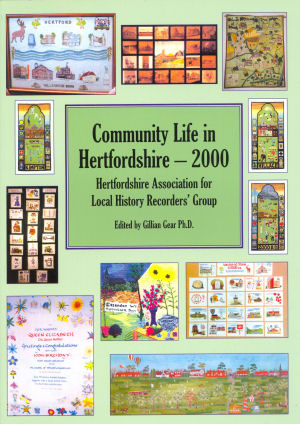
Community Life in Hertfordshire - 2000

This book was produced to record what was happening, relevant to history, across Hertfordshire in 2000. It was written by the local recorders of the Hertfordshire Association of Local History and there are reports on over 60 places (listed on main page, together with the introductory section) and many of these include a brief history, and accounts of local organisations or events.

I am considering a short review describing, as examples, two or three of the reports - and if you add a comment saying which places you are interested in I will consider mentioning them in the review.