
 |
| Photographers |
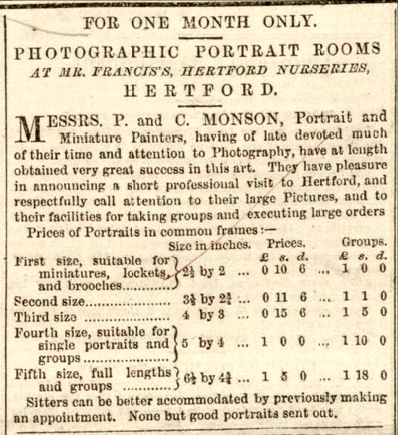 David Simkin, who runs the Sussex Photohistory web site kindly drew my attention to the fact that P & C Monson had been taking pictures in Hertford as early as 1853. I decided to follow this up by using the British Newspaper Archive, via FindMyPast, to see if I could reconstruct the early history of commercial photography in Hertfordshire, using references in the Herts Mercury and the Hertfordshire Guardian, both of which have been digitised for the relevant period.
 |
| Newspapers |
It turns out that a photographer called Mr Williams had been at the Bull Inn, Hertford, in 1851. The first local photographist was a daguerreotypist called H F Cox in Fore Street in 1856 while Hart & Craddock were operating from North Crescent (later Arthur Elsden) in 1857. Charles Forscutt was operating at the Old Cross by 1859 and a plumber called John Charles Garrood started taking photographs in Ware Road, Hertford, in 1864.
I have also added many early photographic adverts to the Arthur Elsden page.

