Friday, January 31, 2014

A WILDMAN at the Red, White & Blue

Brewing
Old Post Cards
In about 1911 someone obviously spent their spare time, probably on a bicycle, touring the pubs in the eastern half of Hertfordshire.  At each pub they collected a post card of the pub, or may have taken a picture themselves, and pasted them in an album. About 90 years later the album fell into the hands of a post card dealer who removed them and sold them one by one on ebay. Post cards of small village pubs are rare and those which were clearly identified fetched high prices but I was able to get 14 whose name or location was unclear. In 2004 I posted them on this site (Post Cards of Hertfordshire Pubs) and by 2007, with the help of others, I had succeeded in identifying every one, and often worked out the name of the publican as well.
The Red White and Blue at Collier's End
Is the publican in the picture Joseph Constable, William Wildman or Robert Champlain?
In the case of the Red White and Blue at Collier's End, part of the historic parish of Standon, there was a problem - as the village had three full public houses and two beer sellers. On the limited information then available to me I surmised that the Smith family were the hosts at the Red White and Blue. Much more information has become available since then and Clive recently informed me that his ancestor, William Smith, died at The Plough. A quick check of the 1911 census showed that a William Henry Wildman was the publican at the Red, White and Blue, and a widow, Sarah Louisa Smith was publican at The Plough.

In updating the page I have also expanded the table of Collier's End publicans to cover the period 1882 to 1926. What is interesting is that there was a high turnover of licencees. In a period of 44 years there were at least 9 different people running the Lambs and Flag, and possibly 10 different people at the Fox and Hounds. 

A useful trip to St Albans

St Albans
Last Saturday I went to St Albans to visit some of the special events for residents which, I now learn are held every year on the final weekend in January, before going to the monthly meeting of the Herts Family History Society.

My first stop was to the North Transept of the Abbey where there was an exhibition of pictures of St Albans about 100 years ago put on by the SAHAAS. It included copies of many pictures by the local artist Holmes Winter, and I plan to do a page on his work later in the year. During the visit I had a talk with a number of members and Jon told me they have now located a map confirming the location of the Chalk Hill and Gorhambury Rifle Ranges.

I then went for a quick cup of hot chocolate in the Abbey Refectory (well worth a stop-over if you are visiting the Abbey).

As you enter the Refectory a doorway takes you upstairs to the Abbey Library where there was an exhibition celebrating the life of Matthew Paris. Matthew was a Benedictine monk who lived in St Albans Abbey - and was a very significant historian, although as he died in 1259 his works have little immediate relevance to most people researching their family history.

I then detoured to a bookshop in St Peters Street (with a small cafe!) where I spent a Christmas book token on a copy of Hertford - A landscape history. It looks like an important document for understanding the development of the county over the centuries - but is more for the local historian than than genealogist. It has been added to my "To review" list
Marlborough Street Methodist Church was next on my list. It was built in 1898 - almost certainly using Jacob Reynolds bricks from Bernards Heath. It has cast iron pillars supporting the gallery and a magnificent organ which was being played while  I was there. I took a number of pictures and have created a page for them and added a short historical text from their exhibition.

I then traveled to Woolmer Green to hear Jon Mein give a talk on the work being done by the First World War Team of the SAHAAS in recording the Military Tribunals during the First World War. Unfortunately the original Tribunal Record have not survived - but those of Middlesex have - showing how much information has been lost. He mentioned Arthur Tyler, who had been a milkman working for my great grandfather at the Heath  Farm Dairy, and who gave his life fighting.

Tuesday, January 28, 2014

Low Water at Startops Reservoir - Picture of the Day on Geograph

Low Water at Startops Reservoir, near Tring, in 2012
It seems somewhat ironic that on January 23rd Geograph selected one of my pictures of the effects of drought on the Tring Reservoirs to be  "Picture of the Day" when a visit I made a few days earlier had shown that all the reservoirs in the area were filled to capacity, much as I reported in a Rural Relaxation note in April last year. This picture shows (not very clearly) part of the medieval ridge and furrow area I reported here on December 3rd 2011 and March 11th 2012.

One of the frustrating things about Geograph's "Picture of the Day" is that the photographer is not told when one of his pictures has been selected and it sometimes appears years after the picture had been added to the web site. (I posted the above picture on January 24th 2012)  I know two other pictures of mine have been selected in the past - but there may have been others.
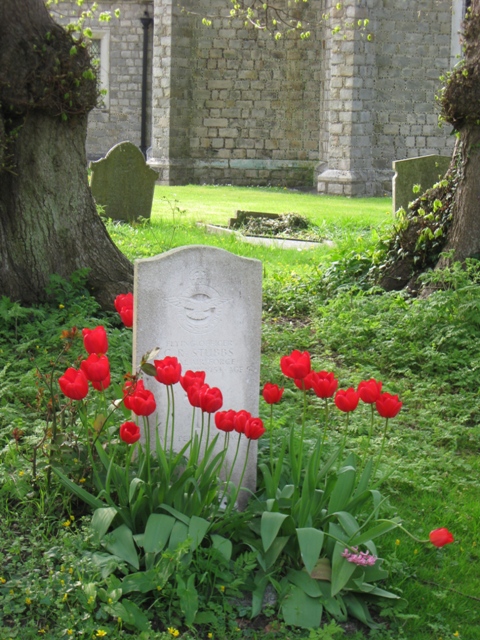
The first was this picture of tulips round a war grave in the churchyard at Halton, Bucks, near Tring, which I took in 2009, together with other pictures of the church and village.

The other was this view of  barges moored on the Grand Union Canal at Marsworth on a frosty winter morning in December 2012.

Monday, January 27, 2014

I have written a Limerick about how to write Limericks ....

A limerick's distinctive metre
Means you do have to know where the feet are
     And of course the fourth line
     With the third line must rhyme
While the last line can be a repeater.

For information on how it came to be written see I don't do Poetry - but now I've written a Limerick on my other blog Trapped by the Box.

Sunday, January 26, 2014

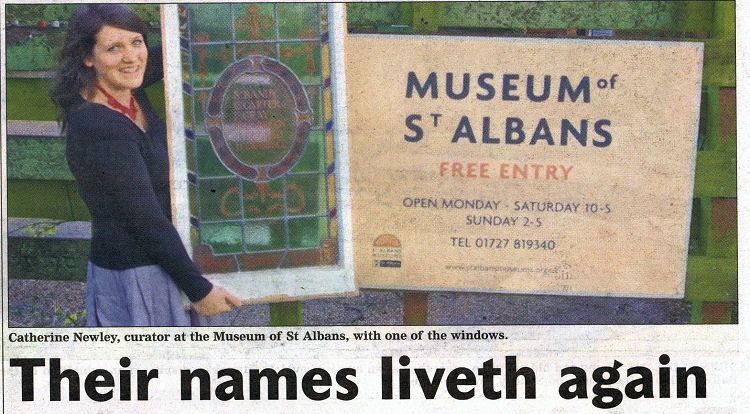
Their Names live again - in St Albans Museum

With the help of this Newsletter these First World War memorial windows from Wheathampstead have found a new home. (St Albans & Harpenden Review, January 22nd, 2014)

Friday, January 24, 2014

From Rags to Riches - This story has everything!

Help Desk
Tring
Mikki recently sent me an update on the page about William Kay of Tring which mentioned that William Kay junior's wife had left about £100,000 to an adopted son in 1894. This sounded interesting so I decided to search for references to the family in the British Newspaper archive - and the more I looked the more interesting it got. The following is a reconstruction of what appeared to have happened.
At the time of the 1851 census Rose Eley was an 18 year old stay maker living in London. She apparently later moved to work in Marylebone for Letitia Reed who ran a fancy repository, and her husband Albert Howard Reed, who was a tailor. While there she met William Kay, who was an extremely foolish and extremely rich young man. Perhaps Albert was well known for the quality of his tailoring, and William went there to buy a suit, and spotted a fair young maid!

William Kay was the son of William Kay senior, who had owned Tring Park but had died in 1838, when his infant young son was made a ward of court. William did not live at Tring, and the mansion and estate was let to Joseph Grout in 1843 and then to the Rev. James Williams.
When William junior was in his late teens, but still a minor, the court gave William an allowance of £1300 a year. In 1852 William met up with a Mr Robert Johnson, and the pair went on a "grand excursion of pleasure" (presumably this means wine, women and song) to France, Italy and Germany. Despite his extremely generous allowance William ran out of money and it would appear that cash was borrowed on the promise that it would be repaid when William was 21 and had direct access to the family fortune.

As soon as William became 21 he married Rose Eley in a quiet wedding in St Marylebone Church, the witnesses being Rose's shopkeeper employers Albert and Letitia Reed. This was definitely not the big society wedding one might expect for someone with William's wealth and as far as I can judge it was not announced in the press. I am sure that his father, if he had still been alive, would have said that another gold digger had been at work attracted by the family fortune.

Of course, once William was 21 there were people who were expecting to be paid on the strength of the promises he had made. But he did not pay - on the basis that debts incurred as a minor were not valid, and this led to him being improperly arrested and held in a private house against his will. (This part of the story need more research.)

It is possible that William wanted a son and heir - but for 10 years nothing happened (gaps like this can be due to venereal disease which seems a real possibility in this case). However in 1864 a son was born - unfortunately stillborn. William died the following year in Paris, and after much legal wrangling Tring Park and the associated estate were sold by auction in 1872, to Baron Rothschild.

It would seem that the widow, Rose Kay, still wanted a son and heir, and (subject to confirmation of a birth certificate) she "adopted" George Louis Howard. He may have been the son of Albert Howard Reed and Letitia Reed, but a baptism in Kent suggests that Rose may have been the mother, and Reed family tradition suggests Albert was the father! George was born in Paddington in the summer of 1866, and was at a boarding school in Tooting, Surrey, in 1881 under the name George Louis Howard Kay.

However, now that Rose was the wealthy one it seems that she may, in turn have been the victim of another gold digger. In January 1868 she married a soldier, James Watkins, late of the 18th Hussars, in St George's, Hanover Square, the service being taken by the Chaplain-in-ordinary of Queen Victoria - definitely a top notch society affair. This did not last long. Rose went to the theatre and discovered that the leading actress was wearing some of her own (i.e Rose's) jewellery! It appeared that James had been having an affair with the actress, and had planned to elope with her to America. While adultery with the actress was not proved, the divorce was granted in March 1870 because of cruelty and another affair with a woman called Douglas. Four years later James remarried an Edith Galsworthy.

I have not so far been able to trace Rose in 1871 or 1881 but in 1891 she was a widow living in Park House, Wetherby Road, Kensington. She died in 1894, and the residue of her will was left in trust to her adopted son. Possibly George was already showing signs of madness at this stage (hence the trust fund would be appropriate), but in the 1901 and 1911 census he was living as a ward of court with the widow of his ?brother? Henry Howard Reed and their family. Eliza (Henry's widow) is describes as of independent means, and in each census there are a number of servants, one being described as a "Lunatic Attendant". It may well be that the household was getting significant income from the trust set up for George, because they were providing the care which might otherwise have to be provided, at even greater expense, by a private lunatic asylum.
The detailed evidence is on the William Kay page, including a report of the divorce and copies of the relevant marriage certificates - so you can see what was written when a divorced person remarries. There are still some gaps in the story - particularly relating to the court cases, and if you can help to fill them why not comment below.

An update of the East Barnet Pages

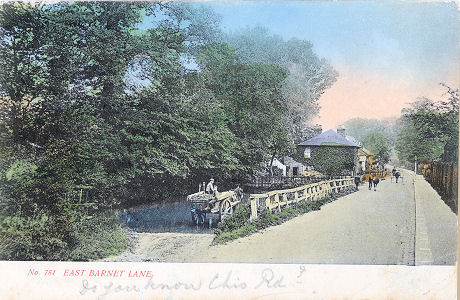
East Barnet Lane
Barnet
Following a query about a post card of the church, I decided to split the page on East Barnet, adding a lengthy description of the church from 1880 (in addition to the 1863 description of the village) and two new post card views. In addition all pictures now have a higher definition picture if you click on them (and even higher resolution are available on request).

By the Grand Union Canal At Bulbourne (near Tring)

The Former Canal Workshops at Bulbourne
Grand Junction Canal

In recent years, particularly when I still had Franci, I have been walking along the many rural footpaths near Tring taking photographs. Many of these have been (and when I have time, still are) posted on Geograph including many taken from the towpath of the Grand Union Canal. 

Recently someone (I am withholding the name to avoid embarrassment) found the above picture on the internet and sent me the following message:

> Re: image for SP9313 (Grand Union Canal: The Bulbourne Workshops)
> Hi, Would like to know if you have any mooring available at present. My boat is 18 meters ?
> Thanks
> Look forward to hearing from you
> regards
> XXXXX XXXXX


When I had stopped laughing all I could do was to reply as follows:

Dear XXXXX,
I am glad you found my picture interesting - but all your can assume from the picture is that on 8th March 2009 I happened to be at Bulbourne with a camera.
I am afraid my camera is much too small for you to moor your boat inside.
All the best along the canal
Chris Reynolds

The Rickmansworth Historical Society

Many of the towns and villages in Hertfordshire now have local history societies which are run by, and for, people who live in the area and hold regular meetings with invited speakers. However many now have web sites, a newsletter, and other publications and even if you live too far away to attend meetings they can be an important source of information.

The Rickmansworth Historical Society is no exception and it is important to note that the Society's activities cover the history of the "old parish area" of Rickmansworth which includes Chorleywood, West Hyde, Mill End, Croxley Green, Loudwater, Batchworth and Eastbury as well as the town of Rickmansworth. They have monthly meetings which include talks of both general and specifically local topics and I note with interest that on the 13th March Bill Templeton is giving a talk on "13 corn and paper mills along the River Chess" which I am sure will include some Hertfordshire Mills such as the one at Loudwater. It has a quarterly newsletter, The Rickmansworth Historian, and there is a index of past issues, and a few selected articles on the web site. I found the article on the web site about Pest Houses very interesting - especially as it included details of a number of Hertfordshire pest houses I had not known about. 

There are a number of publications for sale, only one of which, Rickmansworth - A Pictorial History, I have reviewed on this web site. The latest of their publications is A Village Boyhood in Croxley Green, by Frank Paddick (1909-1965) which tells of a time when life in the village was dominated by Dickinson’s Croxley Mill.

Rickmansworth
Unlike many such local history sites their site does not include a collection of old photographs of the area  - but if you visit the Rickmansworth page of my site you will find many pictures (and additional historical information) ot the town and the surrounding villages.

=============================
If your local history society, museum  or similar group has a web site relevant to local and family history in Hertfordshire why note drop me a line so I can include a review in this Newsletter, which currently gets around 200 hits a day from all over the world. 

Monday, January 20, 2014

Rural Relaxation: The Hamlet of Ringshall, Ashridge

On Sunday the sun came out and I decide to drive to Ashridge to have a walk through the woods and take a few photographs of nature. This was a mistake - everyone had decided to take advantage of the weekend sun and the drive to the Bridgewater Monument had cars parked solidly on both sides, and virtuall all the roadside parking areas were full to overflowing. When I did find somewhere to stop the recent rain, and hundreds of feet, had turned many of the tracks to a sea of mud. However I was close to the hamlet of Ringshall, just on the Bucks side of the County Boundary and about a mile from Ashridge House. As a recent enquiry had involved an ancestor who had worked for Lord Brownlow at Ashridge House, and had lived in one of the estate cottages, I decided to take a picture of some of the former estate cottages.
Ashridge House about 100 years ago - The cottages shown above would have accomodated estate workers.