Showing posts with label rifle range. Show all posts

Sunday, September 18, 2016

Update on the Sandridge Rifle Range

Alan has provided an update on the current state of the former rifle range at Sandridge.
I have recently had a walk in the woods where the Sandridge rifle range was situated. There are two visible brick lined target frame pits up by the remnants of the stop butts. One pit is relatively clear, the other is practically filled in with soil and leaves. The two target pits are a distance of, roughly, 50 yards apart. The pit that is clearer looks about 20 yds. long by 4 yds. by 10 foot deep. It is difficult to say how long the partially buried target pit might be but the stop butt earthworks which serviced this part of the range were not very high and less complete than the other one. From the cleaner target pit is was possible to walk back along the line of the range and find the remnants of three firing point positions that would have been about 100 / 200 / 300 yds. from the target frames. There is also some brick work debris remains and a metal drain cover at the 300 yd firing point. Nothing longer than the 300yds point seems to remain visible. The area outside the woods is agricultural with a recent tree plantation in the area that would have had the longer distance firing points.

Sunday, July 26, 2015

The Sandridge Shooting Range - update

Early in the 20th century the rifle range at Beech Bottom was closed and a new shooting range was opened  to the north of Sandridge. At first I thought it may have been used in the First World War but found that the main range in the St Albans area was at Chalk Hill, to the South West of the City. (DETAILS OF BOTH RANGES).

Mike has just written about investigations relating to the Sandridge range, probably more relevant to the Second World War. He say:

Tuesday, September 23, 2014

The Queens Westminster Rifles at Leverstock Green

Military
I have just posted extracts from The War Journal of Bernard Joseph Brookes which I recorded in 1994 when I was drafting The London Gunners come to Town. It covers the period from August 1914 to the beginning of November, 1914.

My original notes are shown unchanged (apart form some minor formatting differences) but I have added some brief biographical details and a portrait photograph of Bernard taken later in the War.

One interesting a feature is that in 1994 I added a footnote about Military Firing Ranges which reads:
The firing range used was probably in the grounds of Mr Secretan's house, The Dell, at Bennett's End, presumably a disused brick pit. The main military ranges were at Gorhambury, and at Chalk Hill, Westfield Farm, St Stephens. However work on constructing these ranges only started towards the end of September and the earliest record I have found of them being used in November, after the Queen's Westminster's had left Leverstock Green.
So I had the answer to the question "Where is the Chalk Hill firing range?" all along - but in an obsolete format - which my searches were not recognizing it!

Friday, January 31, 2014

A useful trip to St Albans

St Albans
Last Saturday I went to St Albans to visit some of the special events for residents which, I now learn are held every year on the final weekend in January, before going to the monthly meeting of the Herts Family History Society.

My first stop was to the North Transept of the Abbey where there was an exhibition of pictures of St Albans about 100 years ago put on by the SAHAAS. It included copies of many pictures by the local artist Holmes Winter, and I plan to do a page on his work later in the year. During the visit I had a talk with a number of members and Jon told me they have now located a map confirming the location of the Chalk Hill and Gorhambury Rifle Ranges.

I then went for a quick cup of hot chocolate in the Abbey Refectory (well worth a stop-over if you are visiting the Abbey).

As you enter the Refectory a doorway takes you upstairs to the Abbey Library where there was an exhibition celebrating the life of Matthew Paris. Matthew was a Benedictine monk who lived in St Albans Abbey - and was a very significant historian, although as he died in 1259 his works have little immediate relevance to most people researching their family history.

I then detoured to a bookshop in St Peters Street (with a small cafe!) where I spent a Christmas book token on a copy of Hertford - A landscape history. It looks like an important document for understanding the development of the county over the centuries - but is more for the local historian than than genealogist. It has been added to my "To review" list
Marlborough Street Methodist Church was next on my list. It was built in 1898 - almost certainly using Jacob Reynolds bricks from Bernards Heath. It has cast iron pillars supporting the gallery and a magnificent organ which was being played while  I was there. I took a number of pictures and have created a page for them and added a short historical text from their exhibition.

I then traveled to Woolmer Green to hear Jon Mein give a talk on the work being done by the First World War Team of the SAHAAS in recording the Military Tribunals during the First World War. Unfortunately the original Tribunal Record have not survived - but those of Middlesex have - showing how much information has been lost. He mentioned Arthur Tyler, who had been a milkman working for my great grandfather at the Heath  Farm Dairy, and who gave his life fighting.

Thursday, November 14, 2013

Chalk Hill Rifle Range, WW1, at Sandridge or St Albans?

The Military
As part of the research into the First World War in St Albans Jon has discovered a possible "Chalk Hill" in the parish of St Michael [more information]. If this is correct the question then arises as to whether the firing range in Sandridge was used during the war - as it was an obvious and available training resource.

While on the subject I am still trying to find the location of Briton's Camp, which was clearly in the countryside somewhere near St Albans.

Late News: Jon has contacted me with definite evidence of where the Chalk Hill and Gorhambury Firing Ranges were from the Herts Advertiser of 10 October 1914 and the web page has been updated accordingly.

Thursday, March 21, 2013

Hertfordshire Information on the Heritage Gateway

Yesterday Dr Isobel Thompson, of the Historic Environmental Unit at Hertfordshire County Council, gave a very interesting talk on the Hertfordshire Historic Environment Record which holds details of archaeological finds and investigations, and other sites and monuments up to the time of the Second World War. In addition there is a comprehensive collection of air photographs of the county covering the last 40 years. While much of the detailed information is not available online, some is available on the Heritage Gateway web site where a map will show locations of the sites records (and for monuments and some buildings brief information) However you can also see a list of the Hertfordshire records and get a summary of the site record.

Saturday, March 2, 2013

Shooting Match on Sandridge Rifle Range in 1907

from Herts Advertiser, Sept 1907
Old News
I have just posted a lengthy news item reporting on a shooting match between some South African (Boer) War veterans and the St Albans Rifle and Revolver Club. It was held on the comparatively newly built Sandridge Rifle Range - which has earlier been discussed at length under the title Chalk Hill Rifle Range,  Sandridge, First World War. The news article names the teams - and the individual scores at 200, 500 and 600 yards.

Saturday, November 24, 2012

Severn Generations on one farm at Sandridge.

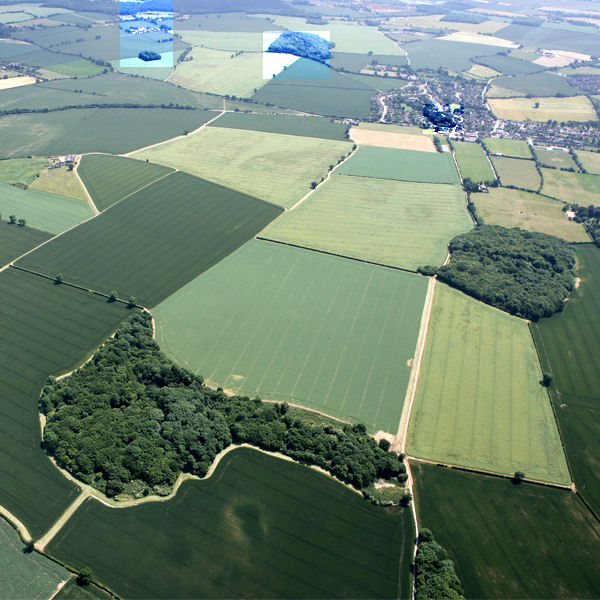
This picture is from the Woodland Trust web site. Almost all the fields, and two large wooded areas are part of Heartwood Forest, a major project to restore a large area of fields to native woodland in Hertfordshire. For a mere £15 you can dedicate a tree to be planted in what will be an 850 acre forest. I already have a page about the new forest but three areas in the picture are of particular interest to my ancestors, in addition to most of Heartwood Forest area having been farmed by a relative in Victorian times.

In the top left is a farm (highlighted) with a spinney in front of it and a light coloured field beyond. The Farm is Hammonds Farm which was farmed by my ancestors, William Cox (1760-1802), Thomas Cox (1794-1874), Henry Cox (1826-1882), Jacob Reynolds (1835-1926) and Harry Finch Reynolds (1865-1947). My father Gerald Finch Reynolds (1907-1977) worked on the farm, and helped to plant the spinney (in part I suspect, as cover for foxes) probably around 1930. When he married in 1937 he built a house, Eylotts, on the light coloured field, which had been the poultry farm area of Hammonds Farm. I was born there (well technically in a nursing home in St Albans) but the farm was sold in 1939. So after 7 generations who had lived at least part of their lives on the farm the family moved away from the area.
The small wood highlighted to the right is the site of the former Sandridge Rifle Range, which extended into the fields in front of it - the trees surrounding the butts. The two fields in front are part of Heartwood Forest and when I visited this summer were full of very young trees, although most were still not higher than the grass..

By the track from Sandridge Village towards Hammonds Farm
The newly planted part of Heartwood Forest is on the left, Range Wood is straight ahead.
Because of my connections with the area the village of Sandridge is of particular interest and many of my ancestors are buried in St Leonard's churchyard - containing the grave of my earliest traced Cox ancestor, Jonathan Cox (1688-1750). If I could link him, and the two intervening generations, to Hammonds Farm this would make 10 generations who lived on one farm.
The Cox Graves in Sandridge Churchyard
The engraved top of the brick vault is now virtually unreadable but originally read
Here Lyeth Inter'd Mrs. Eliz. Cox, Wife of Jonathan Cox, Gent. of St Julians in the Parish of St Stephens
who departed this life January 12, 1740, in the 55th year of her age.
Here Lyeth the Body of Jonathan Cox Gent. Husband of the above Elizabeth Cox who died
Decebr. the 31, 1750. Aged Sixty Two
When the above inscription was recorded, in about 1878, a Jonathan Cox, father and son,
 farmed the land which now forms most of Heartwood Forest.
The other alter grave contains William Cox (1760-1802) and many members of his family
 over several generations. Several of the other stones are also relatives

Friday, August 31, 2012

Chalk Hill Rifle Range, Sandridge, First World War


Bill is researching First World War rifle ranges - and has discovered that there were regulations relating to a Hertfordshire range called Chalk Hill. But where was it?

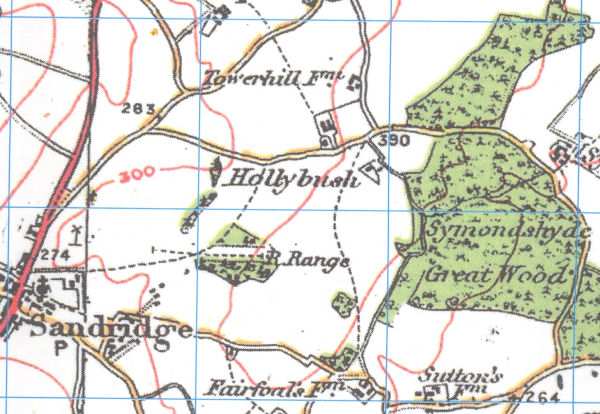
Location of Range on Hammonds Farm

Such questions can be difficult to answer - for instance I am still trying to locate Briton's Camp at St Albans - but in this case Bill was in luck - as there are two mentions of it in my book, The London Gunners come to Town which clearly indicates that there were two ranges available to the 2nd London Division (Territorial Force) when they were based in St Albans in 1914/5. 

While the original records do not specify the exact location there was a rifle range on part of Hammonds Farm, Sandridge and I have presented the evidence that this was almost certainly the right one in Chalk Hill Rifle Range, Sandridge, First World War.

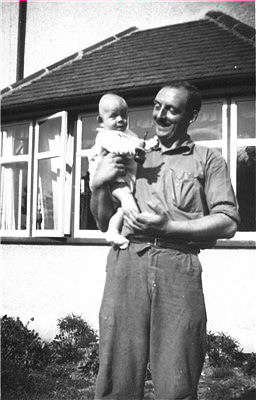
In fact the range is of specific interest to me as Hammonds Farm has been farmed by my ancestors (with one break) between 1803 and 1939. and this picture of me (aged six months) was taken less than half a mile from the range!.

Bill and I have now exchanged notes - and found more evidence about the rifle range. It would seem that the wood was planted to screen the range and it was used by the 8th Battalion Sherwood Foresters in October 1914. It would seem to have been used until the 1950s.